


Physicists Put Penrose’s Idea to the Test: Energy Extracted from Superluminal Motion
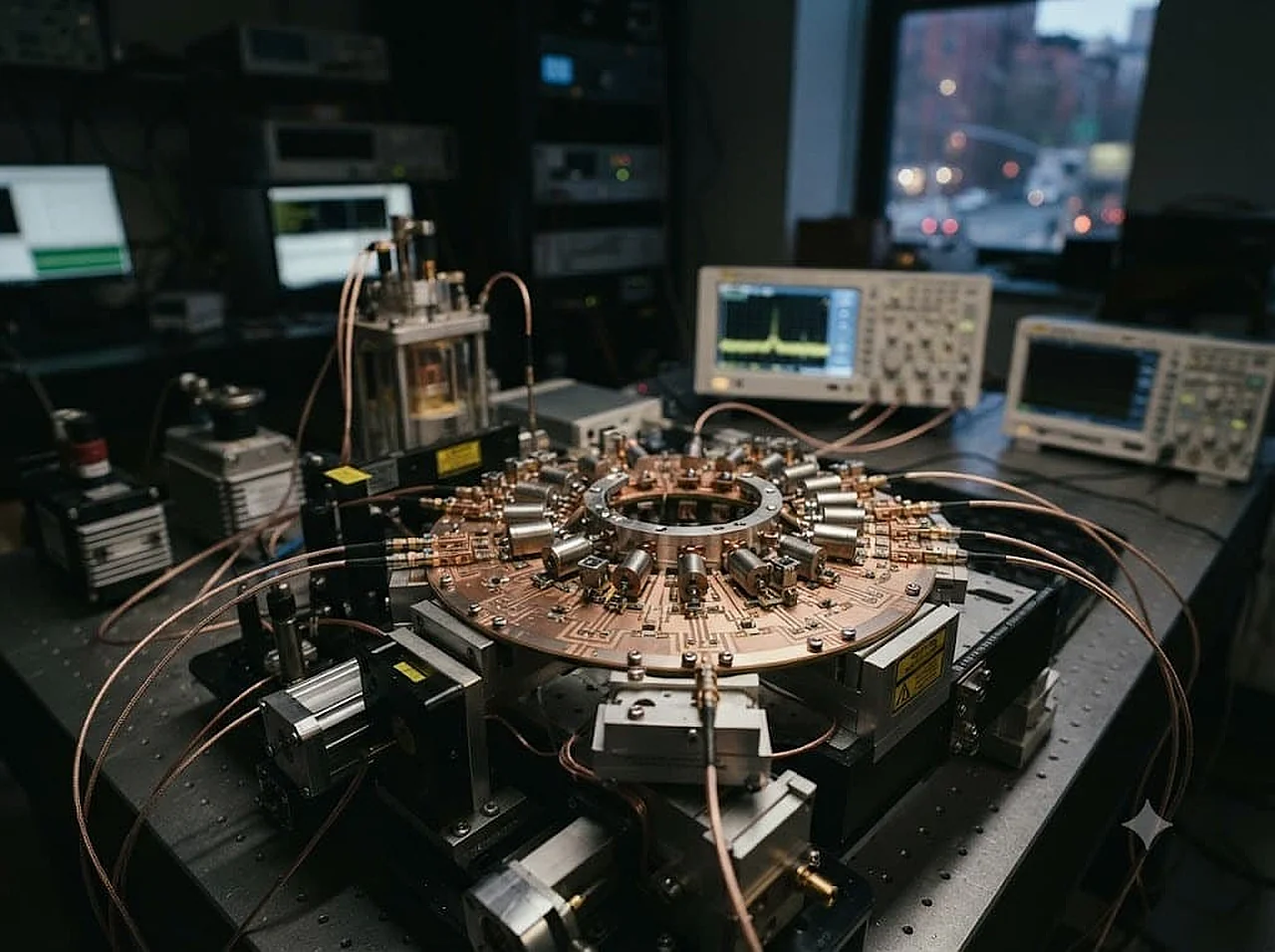
Physicists at the Advanced Science Research Center (ASRC) of the City University of New York have created a unique device that simulates an object rotating faster than the speed of light for electromagnetic waves. The experiment, published in Nature, has taken the Penrose–Zeldovich mechanism from theory into practice for the first time: a process in which a rotating body transfers its energy to a wave and amplifies it. Ixbt.com reports this.
This scientific principle traces back to the idea of renowned physicist Roger Penrose. According to it, when a particle falls into a black hole’s ergosphere, part of it can pass behind the event horizon, while the other part can escape from the black hole with more energy than the original particle. Yaakov Zeldovich later generalized this mechanism, showing that any object rotating at a sufficiently high speed can transfer energy to an incoming wave.
Overcoming Limits Through Synthetic Motion
However, testing this theory in practice remained impossible for a long time because no physical object can be mechanically rotated to such extraordinary speeds. A research team led by Andrea Alù overcame this limitation by replacing physical rotation with synthetic motion resulting from the modulation of a spatiotemporal medium.According to ixbt.com, the device consists of a ring made up of several resonators whose properties change according to a precisely defined program. This makes the wave behave as though it were propagating inside a rapidly rotating object. Although the device itself remains stationary, the modulation pattern moving around the ring is not constrained by mechanical limits, so its effective rotation speed can exceed the speed of light.
Parametric Processes and Practical Prospects
When the effective speed exceeds the speed of light, forbidden gaps for angular momentum emerge in the band structure of this spatiotemporal crystal. This is where parametric processes come into play: waves with the required rotational properties draw energy from the synthetic rotation and begin to amplify.The authors emphasize that this approach creates an entirely new way for waves and material media to interact. Waves with selected properties can extract energy from the synthetic rotation, providing broadband selective amplification.
Bringing extreme rotational dynamics from pure theory into practical experiments through synthetic motion is of fundamental importance for astrophysics, wave physics, and quantum physics. At the same time, the technology opens practical prospects in communications systems, optics, and photonics. The researchers’ next goal is to adapt the method to practical data-processing tasks, including quantum systems.


Comments 0
…