


Turkish scientists uncover the lost secrets of the Solar System
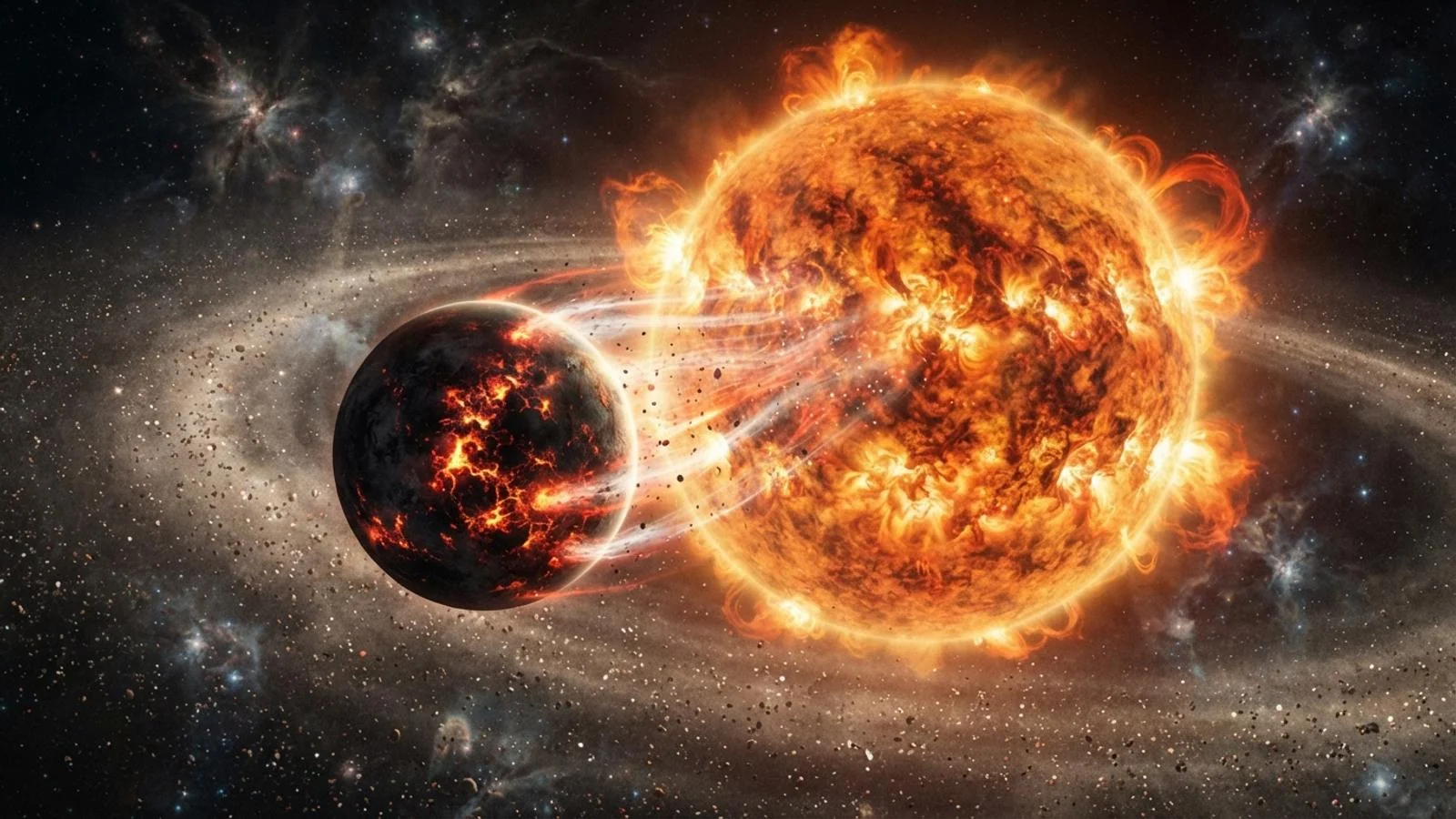
Another intriguing hypothesis regarding the early days of the Solar System has been put forward in the scientific world. According to a study led by Professor Mutlu Yildiz of Ege University and published in the Monthly Notices of the Royal Astronomical Society, a ninth planet existed in the Solar System in ancient times, but it was swallowed by the central star. The study discusses a Super-Earth with a mass 5-10 times that of Earth, which was pulled into the young Sun due to its gravity. This is reported by Ixbt.com reports.
This scientific hypothesis is currently based on a series of indirect evidence rather than direct observation. All of it aims to explain certain inconsistencies in existing models of solar evolution. For many years, experts have been puzzled by the unusually low levels of lithium on the star's surface. It has been determined that the amount of lithium in the Sun is significantly lower than what standard scientific models predicted.
Lithium deficiency and its causes
According to Mutlu Yildiz's calculations, the immersion of a massive Super-Earth into the Sun's outer layers may have pushed a large portion of the lithium in the surface zone into deeper layers. In these deep layers, this element decomposes faster, resulting in a sharp decrease in heavy elements on the star's surface. This process provides a logical solution to the mysteries of the star's surface chemical composition.The second important piece of evidence relates to subtle changes in the star's internal structure. These changes cannot be explained by simple methods without external interference in the early stages of solar evolution. The scientist's mathematical models show that the scenario of a planet passing through the star's outer shells and subsequently melting completely is the most probable case.
A solution to cosmic mysteries
If this new model is confirmed, it could also uncover another ancient astronomical mystery. The fact is that modern observations show Super-Earths are very common in other star systems, yet there is no trace of them in our Solar System. According to Mutlu Yildiz's hypothesis, the answer is simple and surprising: the only such planet was destroyed by the star itself during its formation period.Although this hypothesis remains at a theoretical level for now, it offers science a unique and perfect explanation for existing observational anomalies. In the future, as the study of the Sun and other star systems continues, deeper analysis of the residual traces of such large cosmic events is expected. This will undoubtedly provide humanity with much more new information about the history of our home, the Solar System.


Comments 0
…