


Physicists record Magnus effect in light for the first time
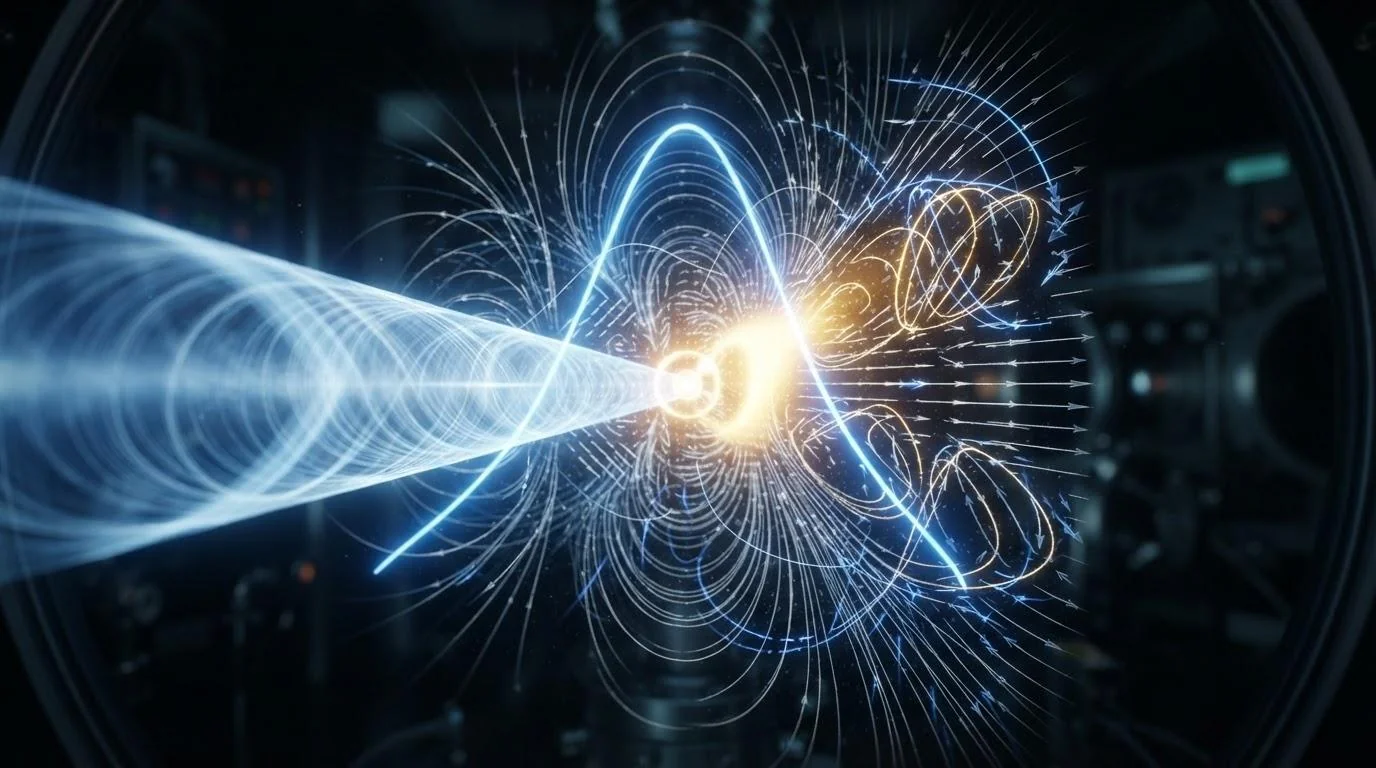
An international team of researchers has experimentally recorded the optical analog of the Magnus effect at the single-ion level for the first time. According to ixbt.com, the interaction between a tightly focused laser beam and an individual atom revealed a theoretically predicted phenomenon, which is crucial for the future development of high-precision quantum computers. This is reported by Ixbt.com reports.
The Magnus effect, well-known from classical physics, is typically observed in the trajectory curvature of a spinning ball. Here, lateral deflection occurs due to forces acting around the object. Although the existence of an optical analog for this phenomenon was theoretically predicted, observing it directly at the atomic level had remained elusive until now. The new experiment has successfully validated these theories in practice.
Experimental process and results
During the experiment, scientists used an electromagnetic trap to study a nearly stationary calcium-40 ion. A tightly focused 729 nm laser beam was directed at it, and the beam was moved relative to the ion in steps. The ion acted as a microscopic sensor, helping to map the structure of the light field.Researchers measured the transition probabilities between different quantum states of the ion based on its position relative to the laser beam. It turned out that the point of maximum interaction did not coincide with the expected point based on light intensity distribution. The observed shifts for two different quantum transitions were 240 nm and 463 nm, respectively, which matched theoretical calculations almost perfectly.
Significance for quantum technologies
The emergence of this phenomenon is linked to the complex electromagnetic structure of tightly focused light. Under such conditions, the longitudinal component of the electric field and spatial variations in polarization play a decisive role. In simpler laser beam models, such factors could usually be ignored.This discovery has significant practical implications for quantum computers. In ion-based quantum processors, lasers are used to control the state of individual qubits. Spatial shifts and polarization non-uniformity can couple the ion's internal quantum state to its motion, potentially introducing errors during operations.
At the same time, scientists believe this effect could be leveraged to create new opportunities. Future research is exploring ways to use these optical forces to enhance interactions between ion qubits and perform more complex quantum operations. The current experiment has successfully created a detailed map of the complex interaction between light and atoms.


Comments 0
…