


Another BRT lane commissioned: A new era in the capital's public transport
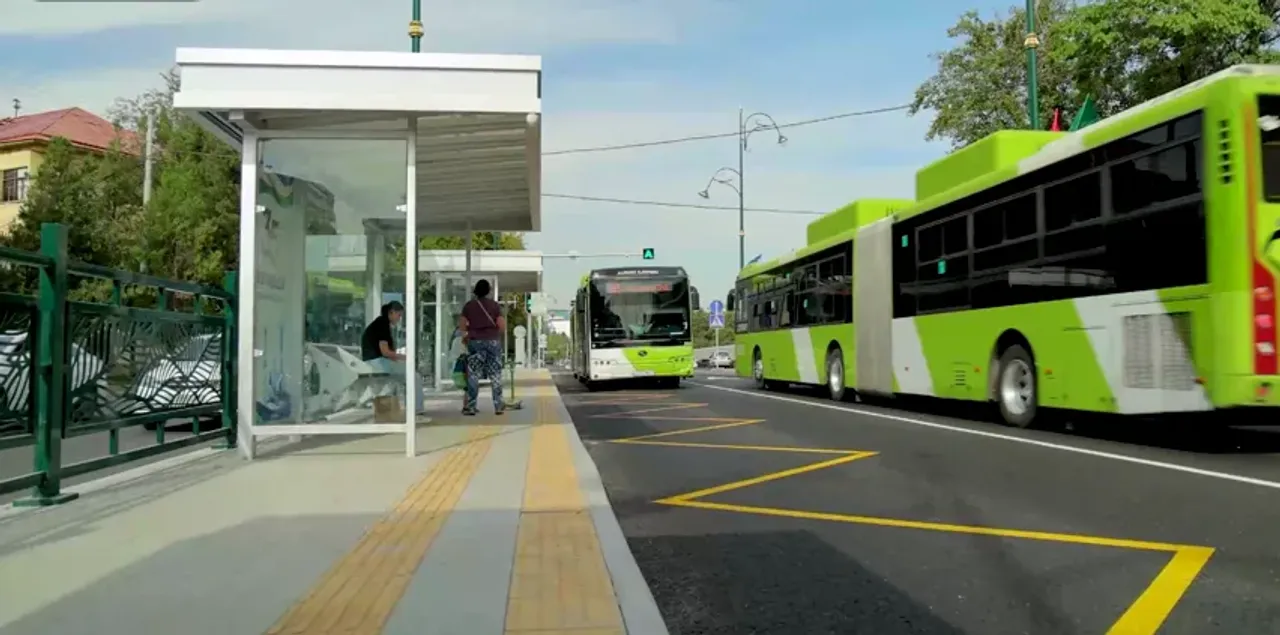
Advanced urban infrastructure that brings public transport movement to a qualitatively new level has been launched in Tashkent. The first phase of the BRT (Bus Rapid Transit) project, which ensures high speed and continuity in the passenger transport system on Shahrisabz Street, has been completed and officially put into operation. The Transport Traffic Management Center reported on this.
The new project covered a 1.2-kilometer central section from the roundabout connecting Shahrisabz, Mirobod, and Shota Rustaveli streets (in front of the former "Grand Mir" hotel) to the intersection with Amir Temur Avenue.
2-meter foundation and geotextile: Why was the subgrade completely rebuilt?
The project did not stop at simply laying surface asphalt. Taking into account that the regular movement of high-capacity buses and electric buses creates heavy loads, the lower engineering layer of the road was re-formed:
2-meter excavation works: In some complex sections, the ground was excavated to a depth of more than 2 meters, and the old loose foundation was completely removed;
Geotextile protection: A special geotextile fabric was laid to prevent underground moisture, soil shifting, and future road subsidence;
Multi-layer reinforcement:
A 35-centimeter-thick dense sand-gravel mixture;
A cement-based reinforcing layer of M-75 grade;
A 9-centimeter-thick coarse-grained heavy asphalt-concrete pavement;
As the uppermost surface layer, a 5-centimeter high-durability SMA-20 (stone mastic asphalt-concrete) pavement was laid.
A separate lane fenced with curbs and 6 new bus stops
The main essence of the BRT system is to make public transport independent of the general flow of cars:
Physical separation: The BRT lane was separated from general traffic lanes by high curbs, which completely restricts passenger cars from entering the bus lane;
6 new bus stops: 6 modern waiting complexes were erected to create convenience for passengers and ensure safe boarding and alighting;
Independence from traffic jams: This solution serves to allow buses to move according to a set strict schedule and stable headway intervals without getting tied up in general traffic jams.
Notably, traffic on Shahrisabz Street was not stopped during all complex construction works: work on the central lanes was carried out in stages, and the traffic flow was diverted through the outer right lanes.
Strategic goals set until 2030
This commissioned 1.2-kilometer road is the first step of the overall project:
Full plan for Shahrisabz Street: The total length of the high-speed lane along this street will be brought to nearly 3 kilometers;
Major goal for the capital: By 2030, the total length of the curb-separated BRT network in Tashkent is targeted to reach 57.5 kilometers, and bus lanes separated by separate "A" road markings are targeted to reach 347 kilometers.
Such infrastructural steps are of great importance in reducing traffic congestion in the capital's center and encouraging the city's population to switch from private cars to convenient and fast public transport.
In your opinion, can dedicated BRT lanes for buses really solve the traffic congestion problem on the capital's streets? Which other busy streets of the city should such lanes be built on first? Leave your thoughts in the comments!



Comments 0
…