


Geksogen engineers charged a smartwatch using hamsters
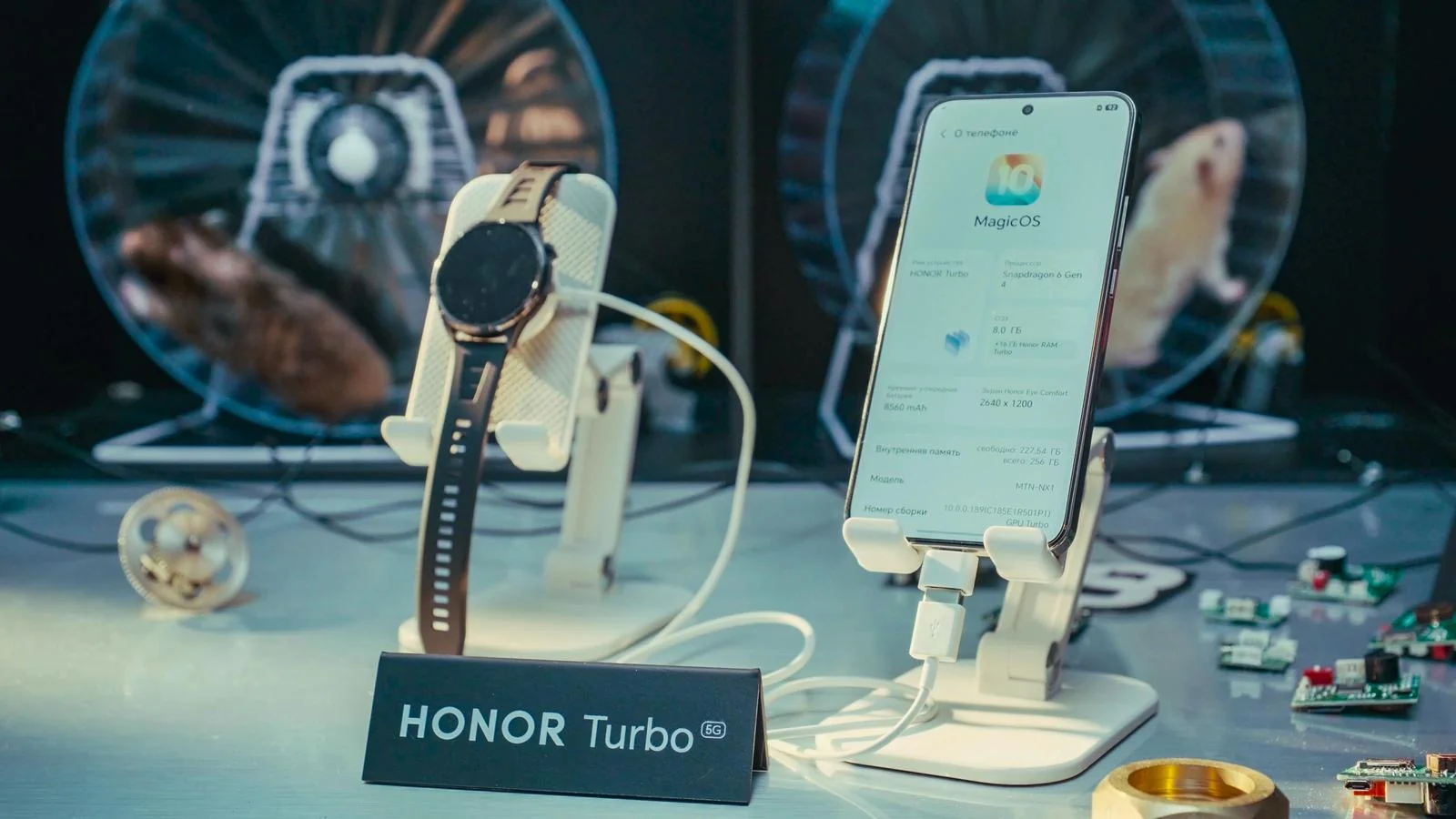
In the world of modern technology, we often witness various strange and unusual experiments. According to ixbt.com, a group of unknown enthusiasts decided to compare the power of mobile gadgets with the physical strength of living creatures. As part of the experiment, they built a unique "living generator" consisting of five hamsters and connected it to an Honor Watch 6. The main goal of this bizarre experiment was to demonstrate the reverse charging capability of modern smartphones not just in numbers, but visually through an "horsepower" analog. This is reported by Ixbt.com reports .
To carry out the experiment, five running wheels with a diameter of 30 centimeters were assembled. Each wheel was connected via a belt drive to a motor-reducer acting as a generator. The engineers explained that the system was equipped with special rectifier diodes to correct the current direction and a supercapacitor to smooth out vibrations. Then, a DC-DC converter stabilized the voltage to 5 volts and delivered it to charge the watch via a USB port.
Experimental process and technical challenges
The project coordinator, engineer Dmitry Sulatskov, noted that hamsters do not move at a steady pace: they speed up, slow down, or stop completely. Since the five wheels rotated independently of each other, the input voltage constantly fluctuated. Nevertheless, the engineers managed to stabilize the current and accumulate electrical energy.The experiment lasted 10 minutes. As a result, a fully depleted comparison object—a watch connected to the wired reverse charging function of an Honor Turbo smartphone—gained 15 percent charge. At the same time, the second watch connected to the generator powered by hamster movement showed only 1 percent charge.
Results and conclusions
Based on the calculated figures, it turns out that five hamsters charged the watch significantly slower than the smartphone. The authors of the experiment noted that one average hamster works approximately 75 times slower than a smartphone. They also estimated the average power of a single rodent to be approximately 0.02 watts.Naturally, many are interested in the safety of the living creatures. According to reports, no animals were harmed during the experiment, and the hamsters performed all actions of their own free will. This interesting experiment once again demonstrated engineering creativity and the unusual approaches that exist in comparing technologies.


Comments 0
…