


Protection against space debris: water-filled aluminum eggs tested
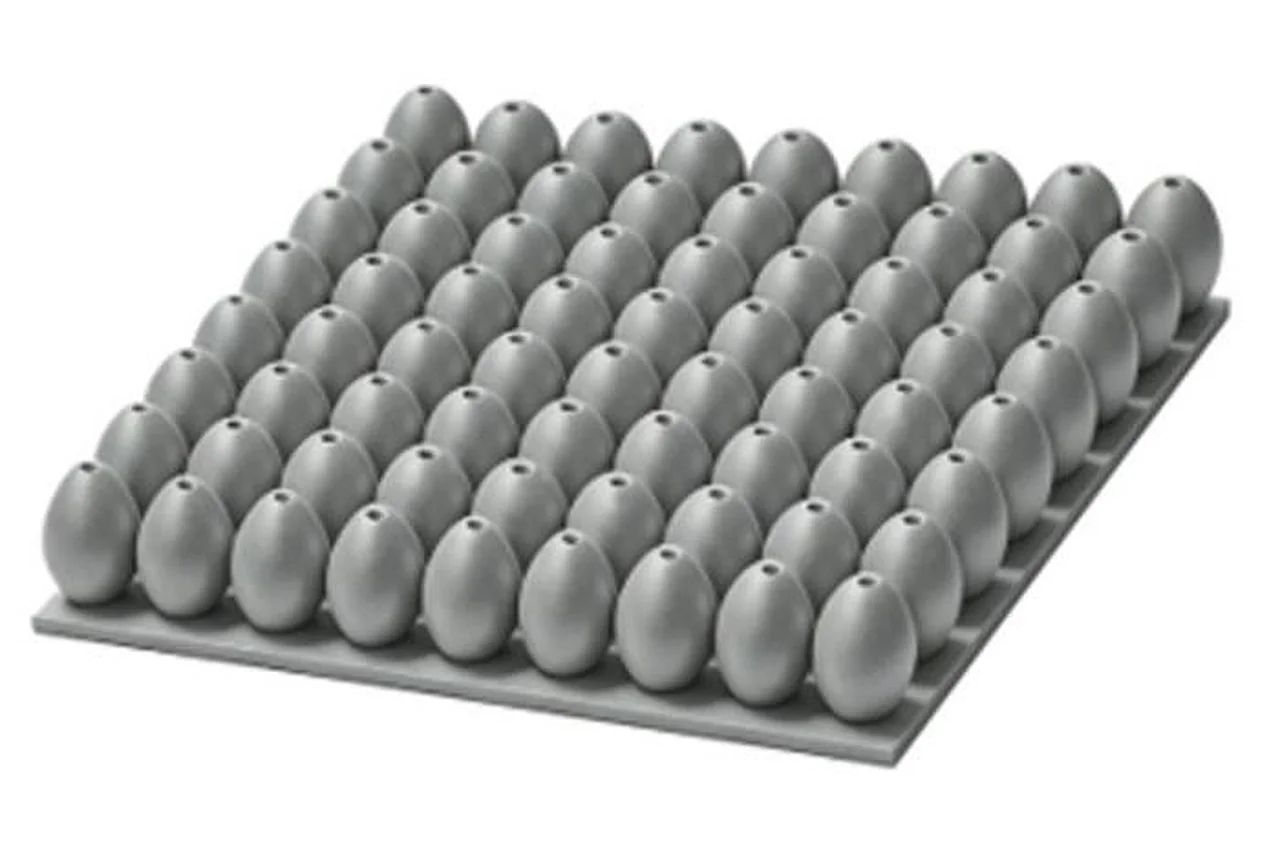
Chinese researchers have created a new lightweight protective structure for spacecraft based on eggshell geometry. According to ixbt.com, an array of hollow elements filled with water and placed between aluminum plates has proven more effective against space debris impacts than traditional solid materials. This is reported by Ixbt.com reports .
In recent years, the number of dangerous debris in Earth's orbit has increased sharply due to numerous rocket and satellite launches. According to NASA, there are over 34,000 objects larger than 10 centimeters, about 900,000 between 1 and 10 centimeters, and nearly 128 million particles smaller than 1 centimeter in orbit. Even such small fragments moving at immense orbital speeds pose a serious threat to spacecraft.
Evolution of space protection technologies
Currently, Whipple shields are primarily used to protect spacecraft. This system consists of a thin outer panel located at a certain distance from the hull, which allows for the dissipation of high-speed impact energy to some extent. However, the new development further improves this principle by proposing the use of complex-shaped hollow elements.The structure developed by experts at Dalian University of Technology consists of water-filled aluminum shells placed between two aluminum plates. One of the study's authors, Yuxin Wan, noted that when such a system is struck, the elements deform sequentially, distributing the point load across the entire array and gradually dissipating kinetic energy.
The importance of water and geometry
Water plays a crucial role in increasing the efficiency of the structure. During a high-speed collision, the liquid moves inside the shell, exerting pressure on its walls and absorbing part of the shock wave. As a result, the energy is distributed more evenly.Experiments and computer modeling results showed that the new array of "egg-shaped" shells managed to reduce impact velocity by nearly 65 percent. For comparison, a simple solid aluminum plate achieved only 51 percent. The best result was recorded in the configuration where the narrow end of the elements faced outward.
In the future, scientists plan to optimize the shell thickness, geometry, and their dimensional ratios to further increase energy absorption efficiency at minimal weight.


Comments 0
…