


Century Discovery in Germany: 934 Silver Coins from the Era of Hadrian Found
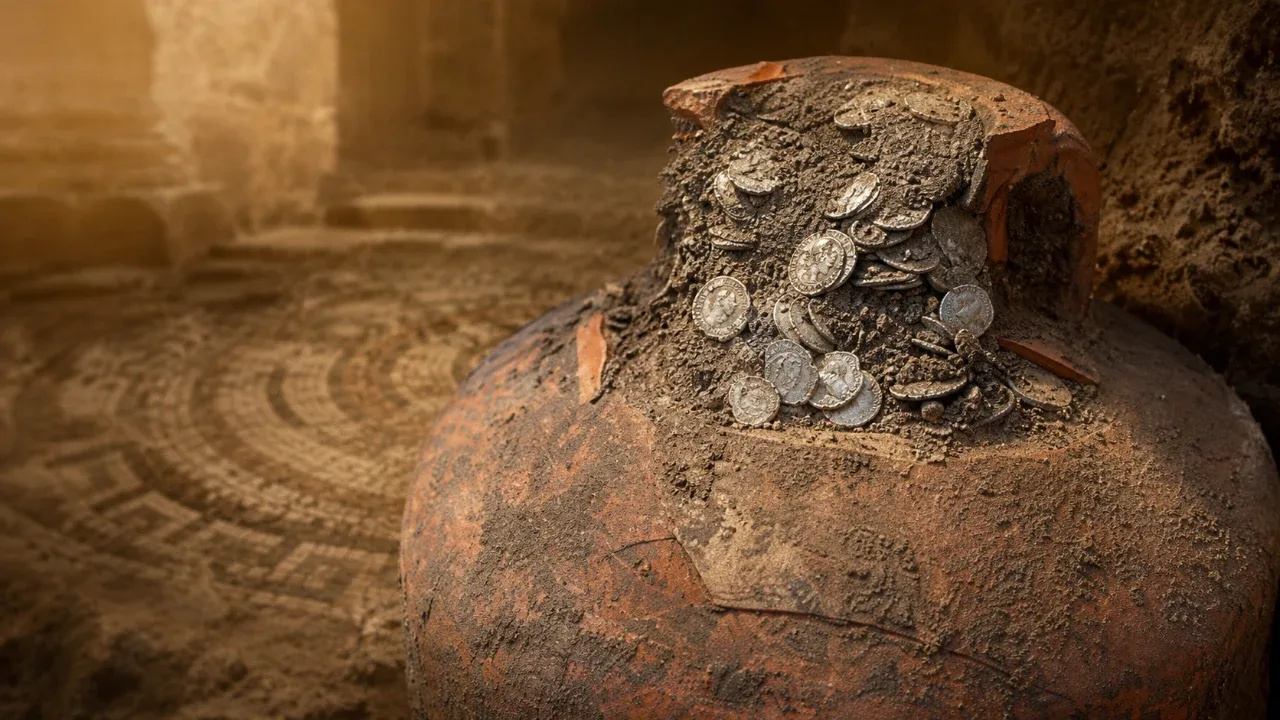
One of the most sensational and unique discoveries in the history of archaeology has been made in an ordinary cultivated field near the German city of Wesseling. A local resident, Oliver Riedel, used a metal detector to find a total of 934 ancient Roman silver denarii weighing 3.1 kilograms.
This was reported by local German media and the Department for the Protection of Archaeological Heritage of the Rhineland Regional Association (LVR-ABR). Due to agricultural work in the field, the original vessel of the buried treasure was damaged and the coins were scattered; therefore, specialists excavated the remaining part together with a solid block of soil and examined it using X-rays in the restoration workshop of the Rheinisches Landesmuseum Bonn.
Laboratory analyses revealed fragments of a clay jug and straw remnants — confirming that these denarii were hidden inside a jar lined with straw. According to experts, the latest coin in the hoard dates back to 124–125 AD, during the reign of Emperor Hadrian. This was officially recognized not only as the largest coin hoard from the Hadrianic era in German history, but also as the fifth largest discovery of this period worldwide.
So, why were the 934 silver coins buried in the field, to whom did the wealth of the Flavian and Hadrianic periods belong, and what new facts do these artifacts bring to the history of the Roman Empire?
"934 silver coins, clay jug, and the Hadrianic era": 5 key points of the Wesseling discovery
The most important facts from Oliver Riedel's discovery and experts' conclusions:
3.1 kg silver treasure: A unique wealth consisting of a total of 934 Roman denarii was successfully excavated from the field;
X-ray and the mystery of the clay vessel: Museum examinations proved that the coins were hidden inside a clay jar lined with special straw;
Flavian and Hadrianic eras: Most of the coins were minted between 69–96 AD (Flavian dynasty), with the latest dating to 124/125 AD (Emperor Hadrian's era);
Absolute record in Germany: A larger complex of Roman coins from this period has never been found in the country until now;
TOP-5 worldwide: This find was recognized as the fifth largest hoard of this period on our planet.
Classification of the Wesseling Hoard: Coin Era and Technical Parameters Table
Historical and scientific characteristics of the excavated artifacts:
Parameters and criteria | Official data and discovery indicators |
Total number and weight of coins | 934 silver denarii, weighing 3.1 kg |
Place of discovery and person | Field near the city of Wesseling / Oliver Riedel (discoverer) |
Era of the main part | 69–96 AD (Era of the Flavian dynasty) |
Date of the latest coin | 124/125 AD (Reign of Emperor Hadrian) |
Conservation and research status | Extracted with a soil block, X-rayed, and sent for restoration |
International and national status | 1st place in Germany, 5th largest hoard worldwide |
Historical and archaeological expertise: Why is this hoard of priceless importance?
Conclusions of archaeologists, numismatists, and Roman history experts:
"A wealthy Roman's savings": 934 silver denarii were an immense fortune at the time, equivalent to several years' salary of a Roman legionary; presumably, a high-ranking officer or merchant accumulated these funds around the 100s AD and hid them in the ground inside a straw-lined jar due to danger;
Military life on the German border: The banks of the Rhine were the northern frontier (Limes) of the Roman Empire where it clashed with Germanic tribes; these coins show how high trade and monetary circulation were in border regions at that time;
Preservation as cultural heritage: Oliver Riedel's handover of the discovery to state inspection rather than hiding it for personal gain allowed unique information to be preserved for science; all coins will be fully restored and placed on museum exhibition.
This silver hoard in Wesseling has revealed a new page of ancient Roman power, trade relations, and the thousand-year history hidden in German soil.
What do you think happened to the ancient owner who buried 934 silver coins in the ground — did he die in a military conflict or was he unable to return to retrieve his treasure? Personally, how do you evaluate the discovery of such artifacts lying in an ordinary field for millennia? Leave your thoughts in the comments and share this interesting article dedicated to ancient Roman history with all your loved ones!



Comments 0
…