


Hubble telescope discovers 'bullets' flying through space at 32 million km/h
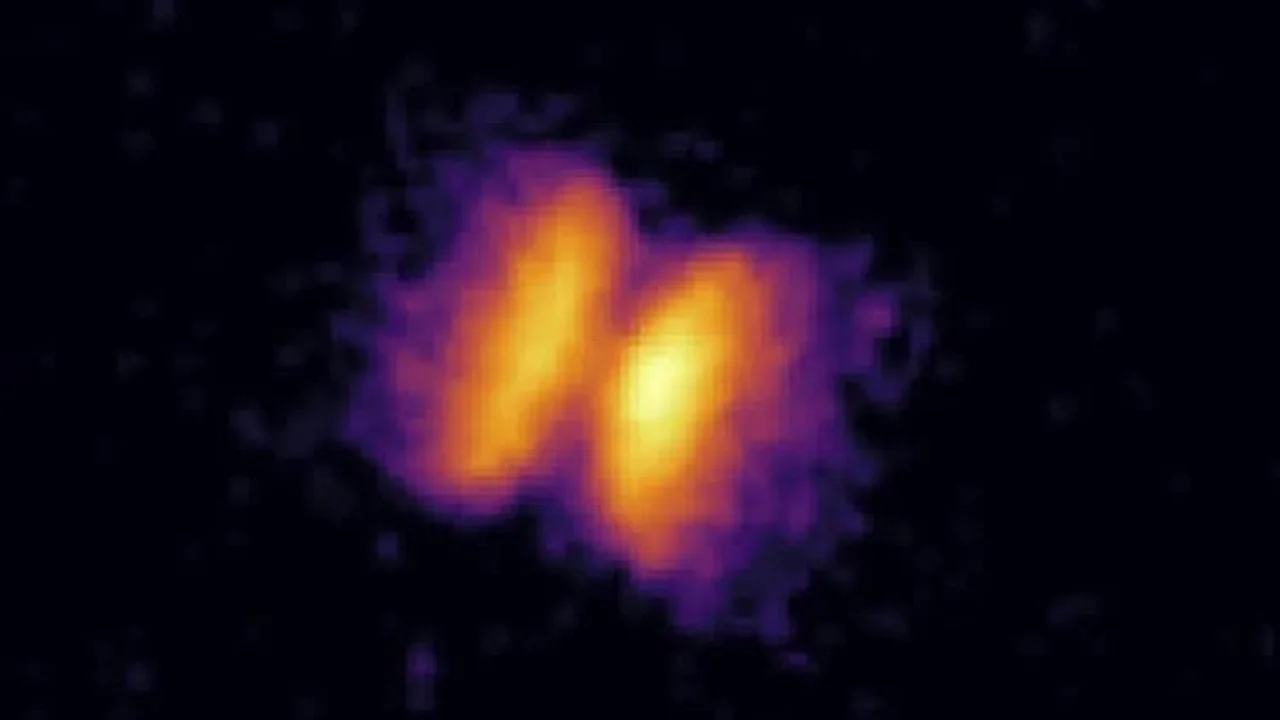
The Hubble Space Telescope, exploring the universe, has recorded an extraordinary phenomenon in the helium nova V445 Puppis, one of the rarest and most mysterious objects in the Milky Way galaxy. Astronomers have identified dense gas clouds ejected from this system at a speed of approximately 32 million km/h. These streams of matter, dubbed 'cosmic bullets' by researchers, are astonishing the scientific world with their unprecedented speed and nature. This is reported by Ixbt.com reports .
The V445 Puppis system is the only known helium nova in our galaxy. While in typical nova stars a white dwarf accumulates hydrogen from its companion, in this system, it draws helium from an unusual star stripped of its hydrogen shell. When the helium accumulation process reaches a critical point, a powerful thermonuclear explosion occurs. It is this process that triggers unique phenomena in the universe.
Discovery after a quarter-century hiatus
The last major flare in this object was observed in 2000. Since then, the system remained hidden behind a thick cloud of dust for nearly a quarter of a century, making observation impossible. Only recently has the dust layer begun to dissipate, allowing major instruments like Hubble, TESS, and the European Southern Observatory's Very Large Telescope (VLT) to study the object again.New observations confirmed that the system indeed consists of a white dwarf and an extremely rare helium star. However, the biggest surprise was the dense gas clumps ejected from the system at immense speeds. According to Ixbt.com, such a phenomenon has not been observed in any other known nova star until now.
Unknown origin
University of Warwick researcher John Mills notes that the origin of these 'bullets' remains a mystery for now. Scientists hypothesize that they may have formed after the explosion, but their high dynamics and density require further study from the perspective of physical laws. Currently, the white dwarf has begun drawing matter from its companion again, which indicates that new explosions may occur in the future.The significance of this discovery lies in the fact that helium novae may be an important stage preceding the formation of Type Ia supernovae. In astronomy, these objects, known as 'standard candles,' serve as a primary tool for measuring distances to remote galaxies and determining the expansion rate of the universe. Through the example of V445 Puppis, scientists are gaining the opportunity to study the most complex processes of cosmic evolution up close.


Comments 0
…