


Universal AI models tested in vehicle control
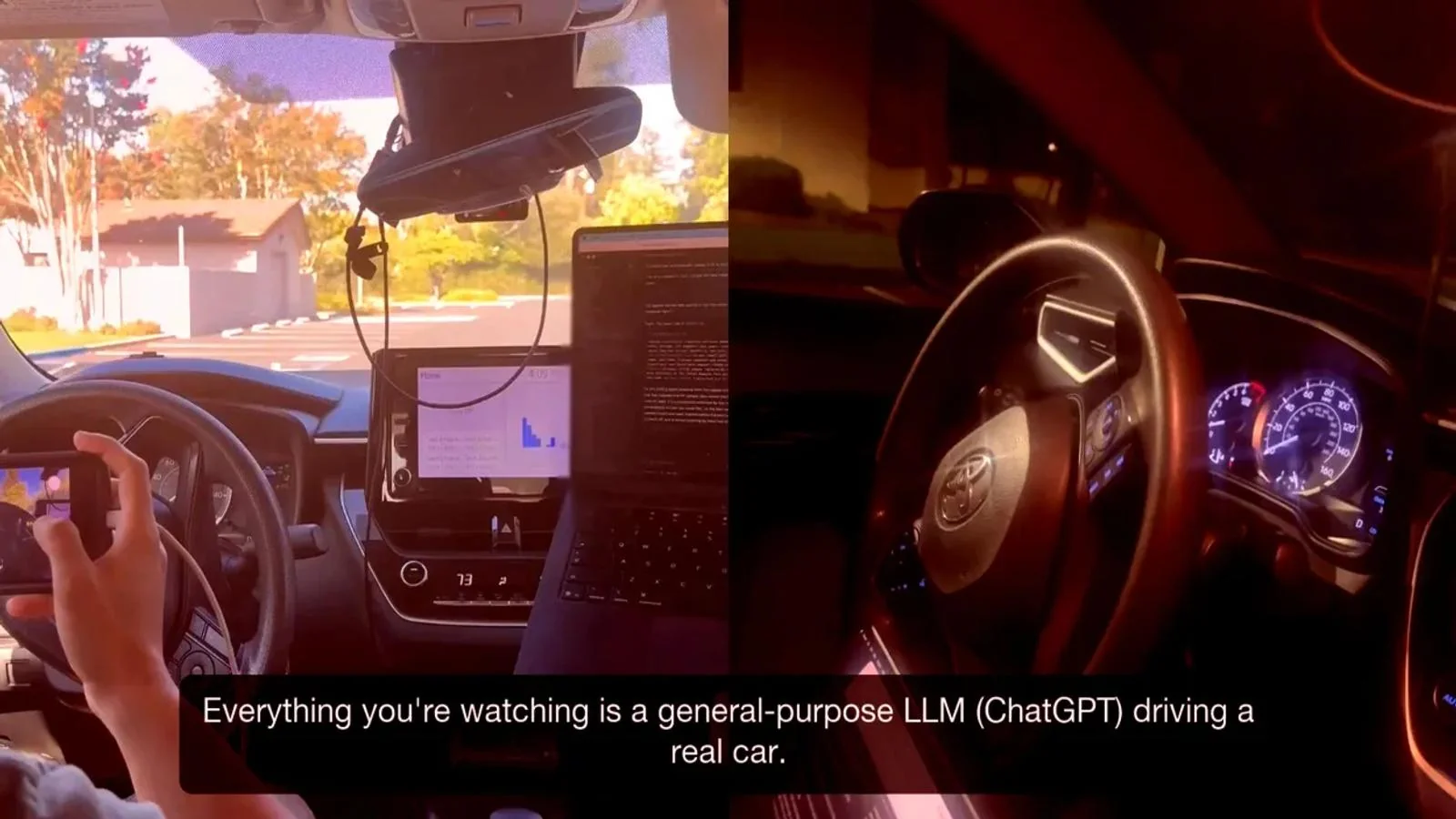
Despite years of development and massive investment, modern autonomous vehicles still face unexpected challenges in relatively simple situations. According to ixbt.com, they encounter issues such as stopping in the middle of the road, hitting obstacles, getting confused in construction zones, or failing to recognize flooded road sections. In this regard, researchers decided to test whether universal AI models, not originally designed for driving, could handle such tasks. This is reported by Ixbt.com reports.
During a unique experiment, experts installed OpenAI's GPT-6 Astra, xAI's Grok 4.6, and Anthropic's Claude Fable 5.1 models on a computer connected to a real Toyota Corolla. The laptop transmitted vehicle parameters, such as GPS data and wheel status, to the car, while the model returned steering, throttle, and brake commands. A human inside the vehicle only monitored the brake pedal but did not steer the car.
Test results and main challenges
During the experiment, the model's task was to independently navigate a parking lot route marked by cones. However, the actual results were far from reliable driving. According to the test results, only GPT-6 Astra was able to complete the trajectory — this was achieved on the second attempt and took 5 minutes. The car moved at a speed of only 0.94 mph (1.5 km/h), covering less than 150 meters. Most of the other models could not even manage the first turn.The authors assessed that the main problem was related to spatial perception. The models incorrectly identified which side of the diagonal cone line the road was on. Specifically, Grok openly admitted after the first attempt that the car was wider than the camera image suggested and that it had misinterpreted the space in front of the vehicle. Nevertheless, this experiment was a significant step in forcing modern universal models to independently control a real car for the first time.
Economic and safety constraints
Experts note that current universal models are capable of performing driving tasks, albeit at very low speeds. However, the results showed that there is still much work to be done on ensuring safety, aligning behavior with established constraints, and refining testing methods. Notably, even the very low-speed movement was costly for the researchers.According to The Register's calculations, for one completed test run, researchers spent $7.74 to process approximately 6.6 million tokens. This is about 500 times more than the cost of fuel for a regular car. This is a significant constraint for autonomous transport, as while the language model can perform the task, its computational costs are completely incompatible with the economics of a standard trip.
Interestingly, some of the models did not want to take control of the car at all. According to the authors, GPT-6 Astra, in particular, repeatedly refused to take control, citing safety concerns even in an empty parking lot with strict speed limits. Despite the researchers modifying their prompts, some models continued to refuse to drive, realizing they were in a real car.


Comments 0
…