


Scientists create a muon laser capable of 'seeing' through two meters of concrete
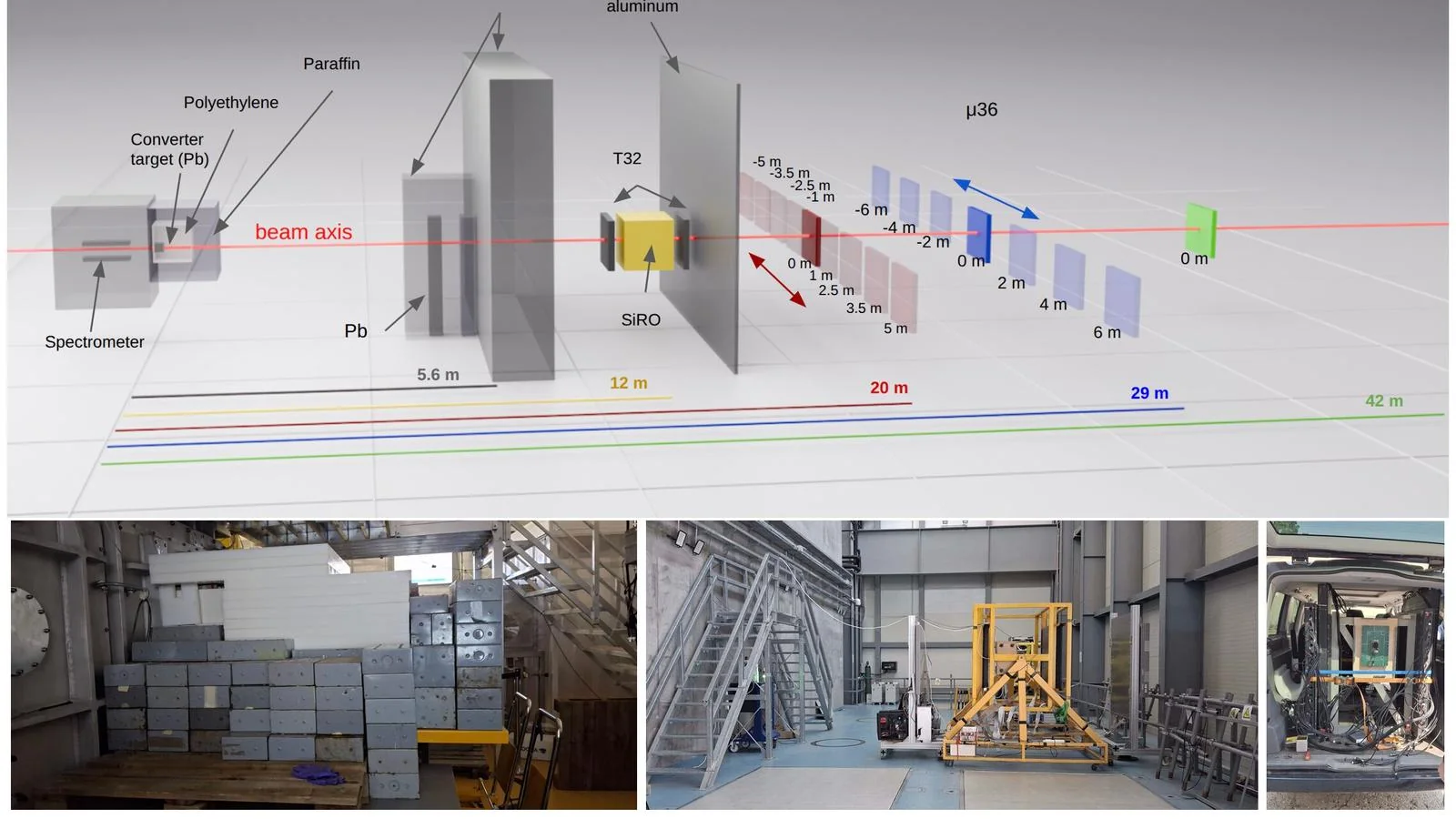
An international team of researchers has successfully captured the first image of an object using artificial muon beams generated by a high-power laser. This significant scientific experiment was conducted at the Extreme Light Infrastructure — Nuclear Physics (ELI-NP) facility in Romania. This was reported by Ixbt.com. reports .
According to ixbt.com, muons are particles similar to electrons but approximately 200 times heavier. This specific property allows them to easily pass through several meters of dense materials such as metal and rock. By analyzing the number of particles that pass through and the change in their trajectory, it is possible to study the internal structure of objects without opening them. This method is called muography.
Artificial muon source and experimental process
Usually, muography uses muons that occur naturally as a result of cosmic rays colliding with atmospheric particles. This method was used, for example, to study the internal structure of the Egyptian pyramids. However, natural muons are relatively rare — about one particle passes through every square centimeter per second. Therefore, it took months of observation to generate a detailed image.To solve this problem, scientists decided to create an artificial muon source. To do this, an ultra-powerful laser was directed at gas, accelerating its electrons to very high energy. Then, the electrons collided with a solid target, creating high-energy radiation that produced muon pairs. To separate the muons from other particles, the resulting beam was passed through a filter made of plastic and paraffin.
Future prospects and practical significance
According to the source, detectors located up to 42 meters from the source recorded the shadow of a stack of lead bricks behind a two-meter-thick concrete wall. The resulting image fully matched the actual position and dimensions of the bricks. Computer modeling showed that nearly 90 percent of the recorded particles were muons.Researchers consider this the first image formed primarily using artificial muons of laser origin. So far, the resolution of such images remains low, so the technology, particularly the lasers and detectors, needs further improvement. Nevertheless, an artificial source allows for muon scanning to be conducted significantly faster and on-demand, without relying on the flow of natural cosmic particles.
In the future, this method could become an important tool for inspecting bridges, buildings, and other large infrastructure, as well as for searching for nuclear materials hidden under thick protective layers.


Comments 0
…