Mysterious rocks resembling a giant fingerprint found on Mars
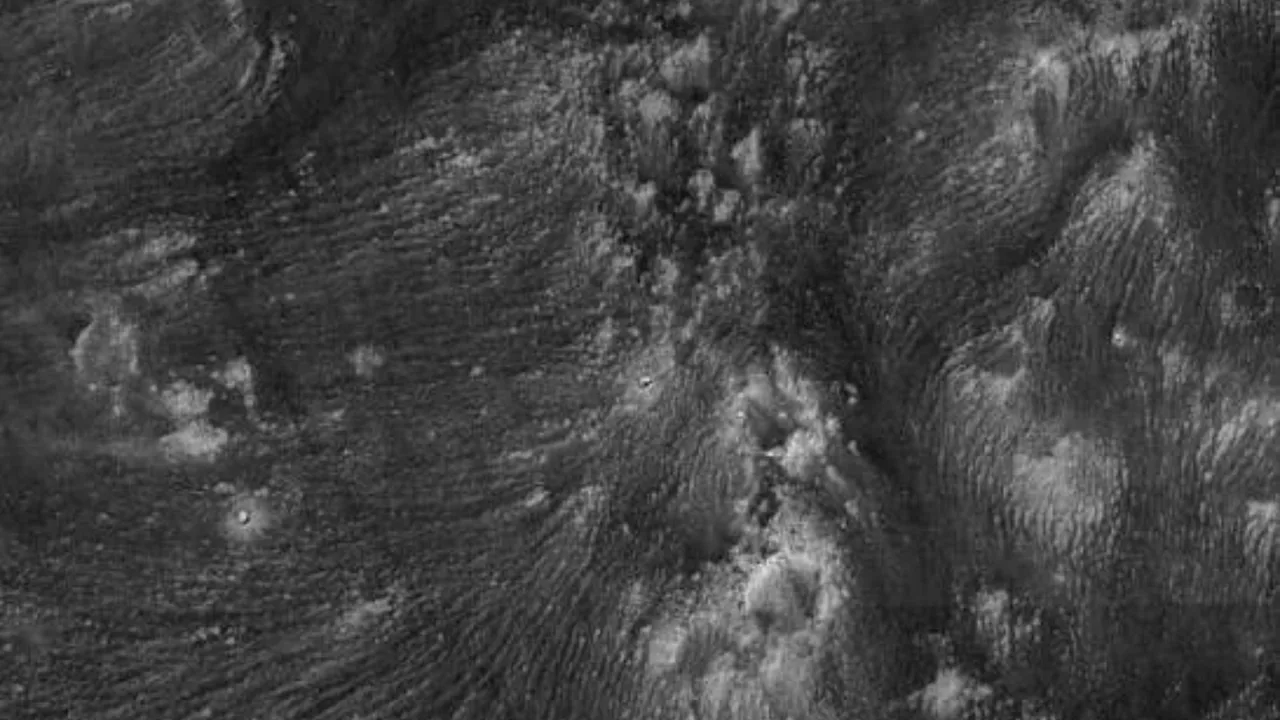
An unusual geological structure that has captured the attention of scientists has been discovered on the planet Mars. Long, winding rows of large, light-colored rocks forming a pattern resembling a giant fingerprint, covering an area of approximately 5 by 15 kilometers, have been recorded on the planet's surface. This was reported by the publication "ScienceAlert".
This unusual landscape was captured using the HiRISE high-resolution camera mounted on NASA's Mars Reconnaissance Orbiter. The images show that the rocks are arranged in a specific order, creating unique geometric shapes on the Martian surface.
It is noted that this mysterious relief is located in the Tharsis volcanic region near the Red Planet's equator, at an altitude of 5,455 meters. Interestingly, archival orbital images taken in 2002 showed this area as almost flat. However, the new images have made it possible to clearly see rows of rocks spaced 5–10 meters apart.
Planetary scientist Paul Geissler of the U.S. Geological Survey has also confirmed the uniqueness of this discovery. Experts have not observed such symmetrical and unique patterns in any other region of Mars to date.
Scientists are putting forward two hypotheses regarding the formation of the rocks
It is not yet clear exactly what process caused the rocks to be arranged in this shape. However, planetary scientists are considering two main scientific hypotheses to explain this phenomenon.
According to the first version, sharp and repeated temperature changes, such as those observed in Earth's polar and high-mountain regions, cause the sorting of rock fragments. In this process, large boulders separate from smaller rocks, forming lines and polygon-like shapes on the surface. Scientists do not rule out the possibility that a similar natural process may have occurred on Mars.
The second hypothesis is related to seismic activity on the planet, i.e., Marsquakes. A phenomenon known as the "Brazil nut effect" may occur during this process. According to it, when the soil shakes, small particles sink to the bottom, while large rocks gradually rise to the surface and accumulate there.
Nevertheless, researchers face an important question: can seismic activity on Mars arrange multi-ton boulders in such a precise geometric order, in the form of winding arcs?
For now, there is no definitive answer to this question. Scientists continue to study the origin of the unusual rock structures. This discovery has once again shown that there are many geological phenomena on the Martian surface that have not yet been fully studied and whose nature remains a mystery even to scientists.

No ads with a subscription
Zamin Premium — 4 900 UZS a month


Related news


Comments0
…