


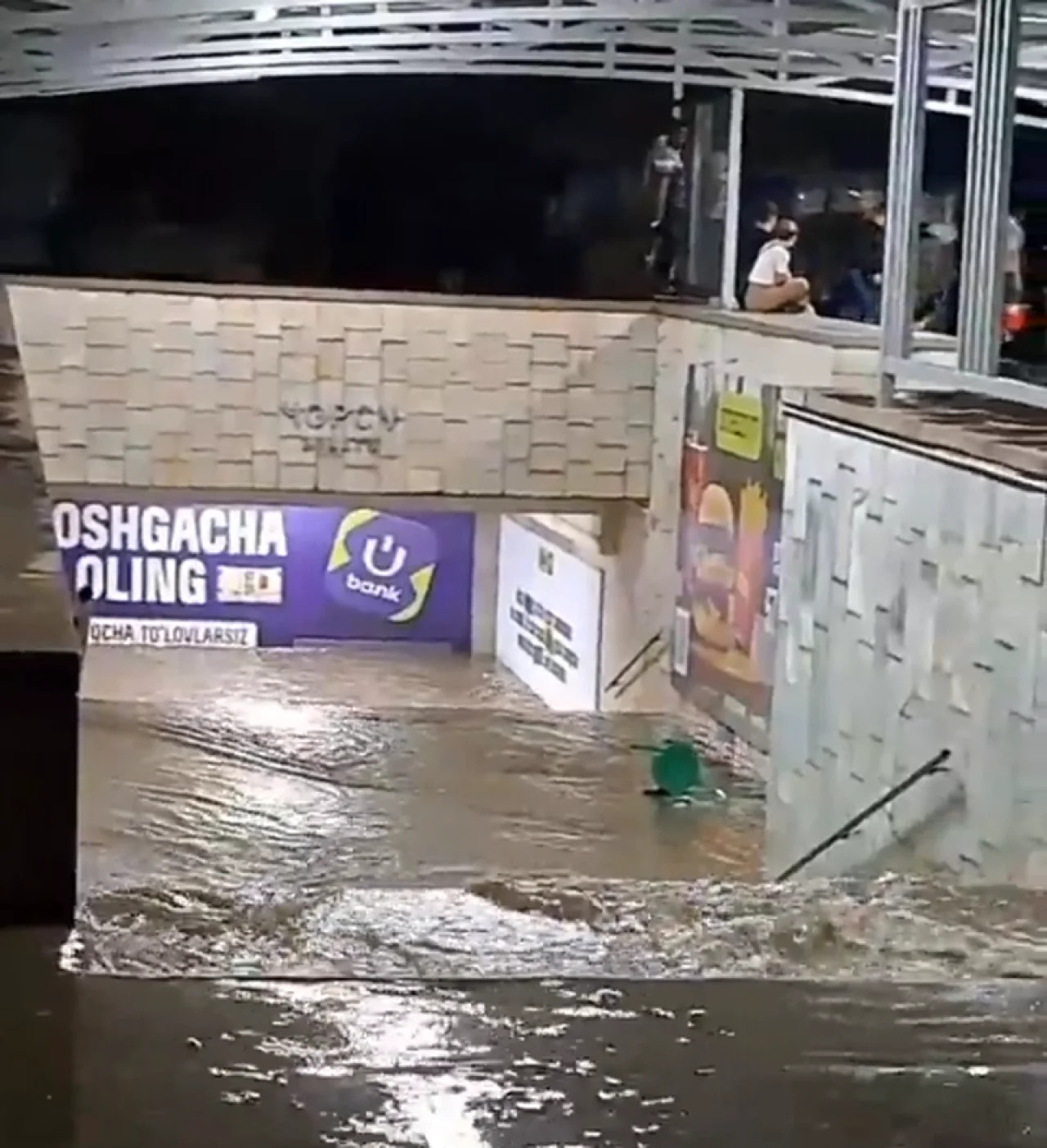
Flooding issue at Chorsu metro station recurs
Quick readAI-generatedShow
- The "Chorsu" metro station in Tashkent has once again been flooded due to heavy rainfall, highlighting a recurring systemic issue rather than a random occurrence.
- Experts, including climatologist Erkin Abdulahotov, noted that similar flooding incidents have been observed in the past, such as in May 2014 and April 2023, indicating that the problem has not been resolved over time.
- Despite the recent rainfall being less intense compared to historical records, the city's infrastructure weaknesses have led to repeated flooding.
- This situation underscores the urgent need for modernization of urban infrastructure to prevent future occurrences.
Heavy rainfall in Tashkent has once again left the entrance to the Chorsu metro station submerged. Experts emphasize that this is not an isolated incident, but a systemic problem that has been recurring for years.
According to climatologist Erkin Abdulahatov, this is not the first time such a situation has been observed. He noted that a similar incident occurred in May 2014, and in April 2023, several metro stations in the capital were flooded. This indicates that the issue has not been resolved over time; rather, it continues to repeat.
Yesterday's rainfall was not distributed evenly across the regions. The rain was significantly more intense in the Shaykhontohur, Uchtepa, and Chilanzar districts, where some automatic stations recorded 4.6 mm of precipitation in just 1.5 hours. At the same time, only 0.3 mm of rain was recorded at the Tashkent Observatory in the Yunusabad district.
For comparison, 29 mm of rain was recorded in a short period in 2014. This demonstrates that even though the current rainfall was not as heavy, the vulnerability of the infrastructure has once again brought the problem to the surface.
Abdulahatov also touched upon historical data. He stated that over the last 170 years, the highest daily precipitation was 50 mm on May 28, 1895, and 49 mm was recorded in 1969. Compared to these figures, the current rainfall was significantly lower, yet the problem persists.
In the expert's view, shortcomings in infrastructure and a lack of sufficient measures taken over many years are the reasons why such situations continue to occur. At the same time, videos depicting this incident have also circulated on international platforms.
In short, this event has once again highlighted the need to modernize the city's infrastructure. Otherwise, there is a high probability that such incidents will continue to occur in the future.



Comments 0
…