


Heavy hail hits Namangan: 18 anti-hail rockets deployed
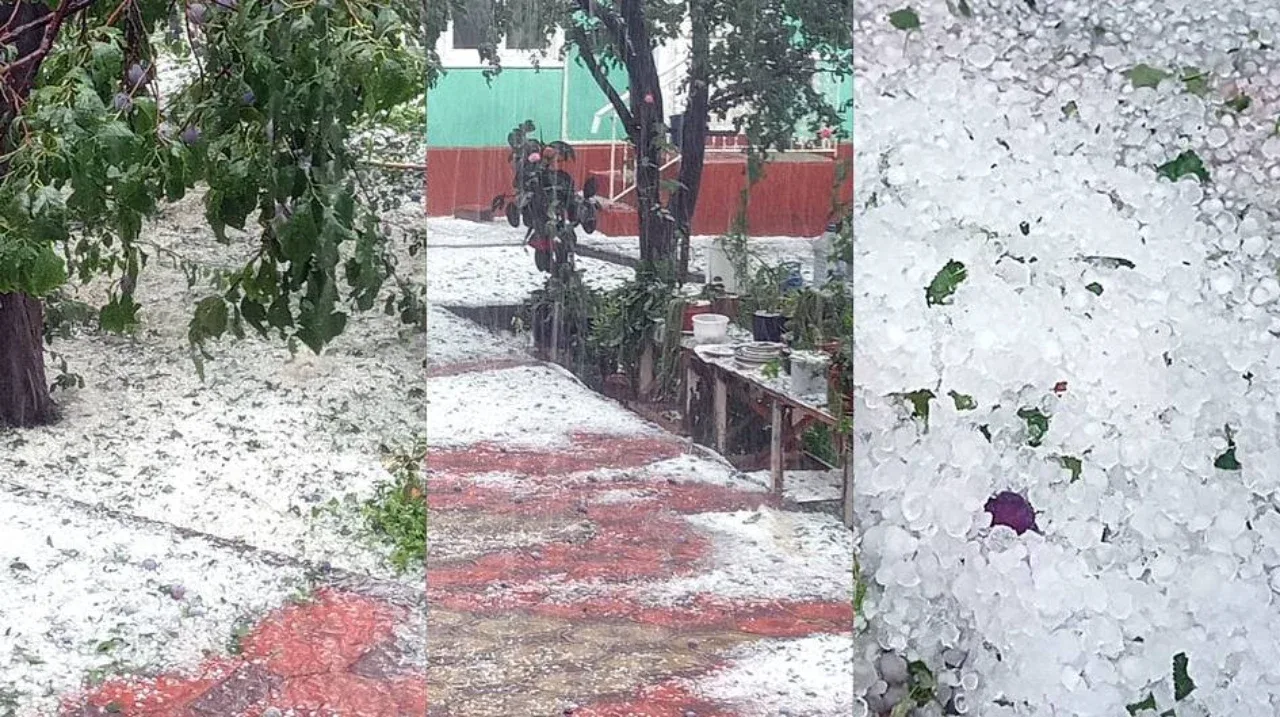
On July 23, a heavy hailstorm hit the Yangikurgan district of the Namangan region, turning some roads white within minutes. Footage circulating on social media shows traffic disruptions and damage to fruit trees.
Notably, special measures were taken in the area to mitigate the impact of the hail clouds. According to Uzhydromet, 18 "Alazan-6" anti-hail rockets were deployed in just five minutes.
Roads turned white in a short time
The natural phenomenon occurred in the Yangikurgan district in the second half of the day. As a result of the heavy hail, roads and open areas were covered with a white layer.
The photos and videos shared show the density of the hail, with some vehicles moving slowly. The slippery road surface posed an additional risk to drivers.
According to preliminary information, the incident also caused damage to fruit trees. However, the total amount of damage to agricultural crops and orchards has not yet been disclosed.
Hail clouds entered from Kyrgyzstan
Uzhydromet explained that the phenomenon was caused by a convective hail cloud entering from the territory of neighboring Kyrgyzstan.
Convective clouds form as a result of warm, moist air rising rapidly. Such clouds can bring heavy rain, thunderstorms, wind, and large hail.
Official data stated that anti-hail measures were carried out from 12:29 to 12:34.
Key Information | Detail |
|---|---|
Location | Namangan region, Yangikurgan district |
Date | July 23 |
Anti-hail operations | 12:29–12:34 |
Equipment used | 18 "Alazan-6" rockets |
Main objective | Protecting crops, orchards, and vineyards |
How does "Alazan-6" work?
"Alazan-6" is a special 82-millimeter caliber rocket designed to protect agricultural areas from heavy hail.
It is launched into the cloud layer where hail is forming and disperses a special reagent inside the cloud. In most cases, substances like silver iodide are used for this purpose.
The reagent helps form more tiny ice crystals in the cloud. As a result, the moisture is distributed among many small particles rather than a few large hailstones.
The purpose of this method is to:
limit the growth of hailstones;
turn them into smaller, less dangerous particles;
reduce damage to crops and orchards.
However, this technology does not completely dissipate the cloud and does not provide an absolute guarantee that hail will not fall. Its main goal is to weaken the intensity of the process.
57 units were also used in May
Special anti-hail measures have been used in the Namangan region before.
According to official data, a total of 57 "Alazan-6" rockets were used in the area on May 1, 11, and 12. It was reported that the measures taken at that time successfully weakened the hailstorm.
Such measures are particularly important for regions with developed horticulture and agriculture during the spring and summer months. Large hail can cause significant damage to fruit harvests, vineyards, and vegetable crops within minutes.
Damage amount not yet known
Following the incident in Yangikurgan, it is reported that fruit trees were damaged. However, an official report regarding the affected area, the extent of crop damage, and the amount of material loss has not yet been provided.
Additional information regarding the situation in the area may be disclosed after the relevant organizations complete their assessments.
Did you experience such heavy hail in your area? If you have photos or videos, leave them in the comments and send them to your loved ones as a warning.



Comments 0
…