


SSS apprehends 4 men who opened a secret drug lab in a rented apartment in Chirchiq (video)
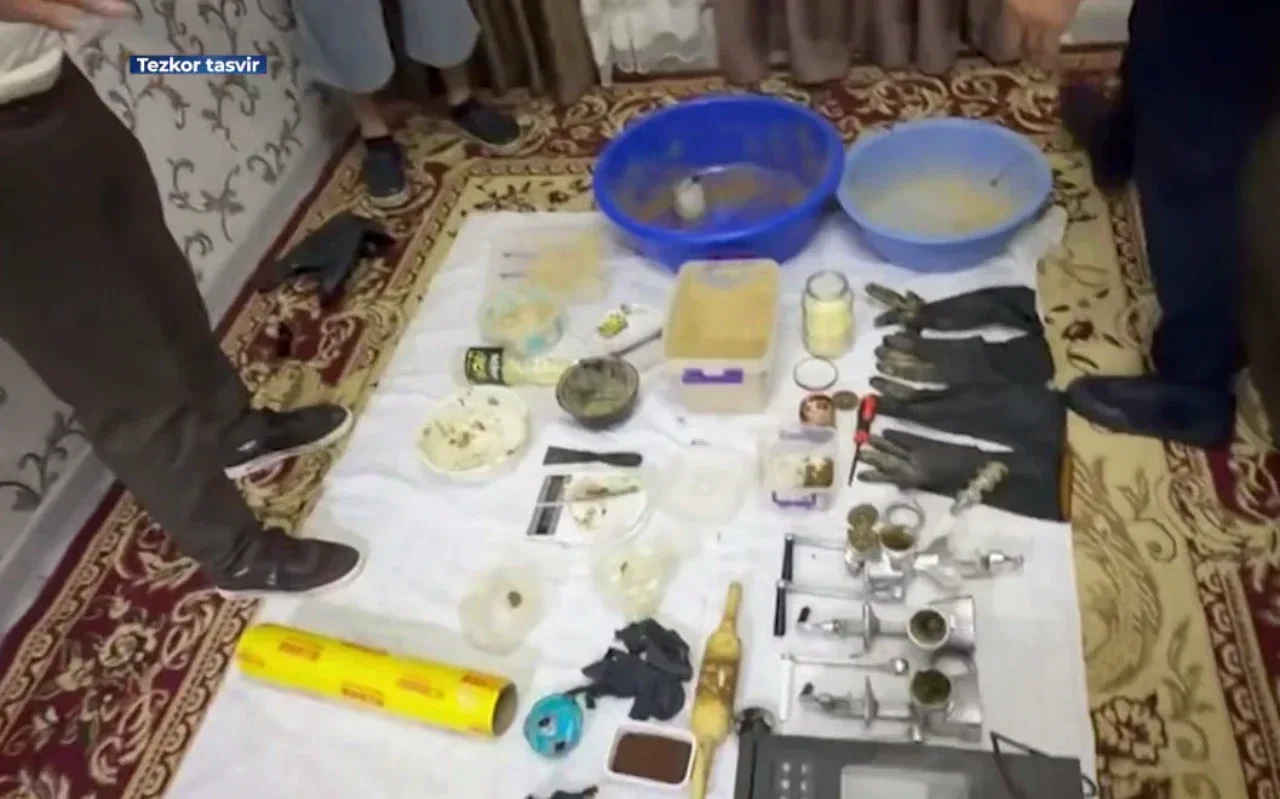
A dangerous transnational criminal chain threatening the minds and health of young people has been exposed in the Tashkent region. During an operational raid conducted by the State Security Service (SSS) of the Tashkent region in cooperation with the regional Department of Internal Affairs in the city of Chirchiq, the activities of a secret drug laboratory established in one of the multi-story residential buildings were shut down.
It turned out that four citizens, born in 2000 and 2002, had rented an apartment in the city, where they were engaged in the industrial and laboratory-scale production and distribution of narcotic substances. The suspects communicated with unknown curators abroad via the Telegram messenger, preparing pure "hashish" by processing "hashish oil" and semi-finished raw materials delivered through smuggling channels.
During the operational search, approximately 400 grams of finished "hashish," 5 kilograms of semi-finished products, special electric drying ovens, mixers, electronic scales, and chemical protective equipment were confiscated as material evidence. The most sensational aspect of the investigation is that two members of the group had "studied" drug synthesis in laboratory conditions in Vietnam and Thailand, and another in Russia. Currently, a serious criminal case has been initiated against them under Article 276¹, Part 3, clauses "a" and "b" of the Criminal Code of the Republic of Uzbekistan.
So, how did these 22-24-year-old men establish contact with drug cartels abroad, where was the prepared poison planned to be distributed, and what severe punishment awaits them?
"Chemical ovens in the apartment, 5 kg of raw materials, and foreign experience": 5 key points of the special operation
The most important facts regarding the secret drug laboratory case exposed in the city of Chirchiq:
A secret factory in a multi-story building: 4 individuals born in 2000 and 2002 turned a rented apartment in Chirchiq into a drug production workshop;
Virtual curation via Telegram: Foreign curators supplied "hashish oil" and semi-finished raw materials through smuggling channels;
Confiscated dangerous substances: Operational officers seized 400 grams of finished "hashish," 5 kg of semi-finished mixture, and professional laboratory equipment;
Southeast Asian "school": It was determined that two of the detainees gained "experience" in preparing drugs in laboratory conditions in Vietnam and Thailand, and another in Russia;
Criminal case involving dangerous substances: A criminal case was initiated against the suspects under Article 276¹, Part 3 of the Criminal Code, and a preventive measure of detention was applied.
Drug laboratory in Chirchiq: Indicators and evidence of the operational raid
Details of the crime and the items confiscated by the SSS and the Department of Internal Affairs:
Indicators and criteria | Evidence and situation identified during the raid |
Location of the incident | Chirchiq city (Rented apartment in a multi-story residential building) |
Detained individuals | 4 citizens (youths born in 2000 and 2002) |
Confiscated finished substance | Approximately 400 grams of pure "hashish" |
Semi-finished drug raw materials | 5 kilograms of semi-finished mixture and "hashish oil" |
Laboratory equipment | Electric drying oven, mixer, electronic scale, plastic containers |
Foreign contacts and expertise | 2 studied in Vietnam and Thailand, 1 in Russia |
Communication and management channel | Unknown foreign curators on the "Telegram" messenger |
Initiated article | Article 276¹, Part 3, clauses "a", "b" of the Criminal Code |
Criminalistics and security expertise: Why is this situation a serious signal?
Key conclusions of law enforcement analysts and experts:
"Imported" criminal knowledge: The fact that criminals traveled to countries like Vietnam, Thailand, and Russia to specifically learn how to synthesize and process narcotic substances shows that a new dangerous trend has emerged in Central Asia;
Multi-story buildings as a mask: To remain unnoticed, criminals are choosing not remote areas, but densely populated rented apartments in multi-story buildings; this puts the lives of surrounding neighbors and civilians at risk of chemical poisoning or explosions;
The danger of "Telegram" networks: Foreign drug curators attract local youth with promises of large sums of money, using them as "cheap labor" and leaving them to take the fall first if danger arises;
Inevitability of severe punishment: The legislation provides for the most severe punishment in the form of long-term imprisonment for persons accused under Article 276¹, Part 3 of the Criminal Code, and such crimes are not forgiven.
This prompt and successful operation by SSS and Department of Internal Affairs officers prevented the spread of a massive volume of narcotic substances that could have poisoned thousands of young people.
In your opinion, what mechanisms are needed to strengthen control over apartments rented out in multi-story buildings? What role should the mahalla and family play in preventing young people from going abroad and getting involved in such criminal networks? Leave your personal thoughts in the comments and share this important analytical article, which concerns our safety, with all your loved ones and parents!



Comments 0
…