


SpaceX Falcon Heavy successfully launches new Nancy Grace Roman telescope into space
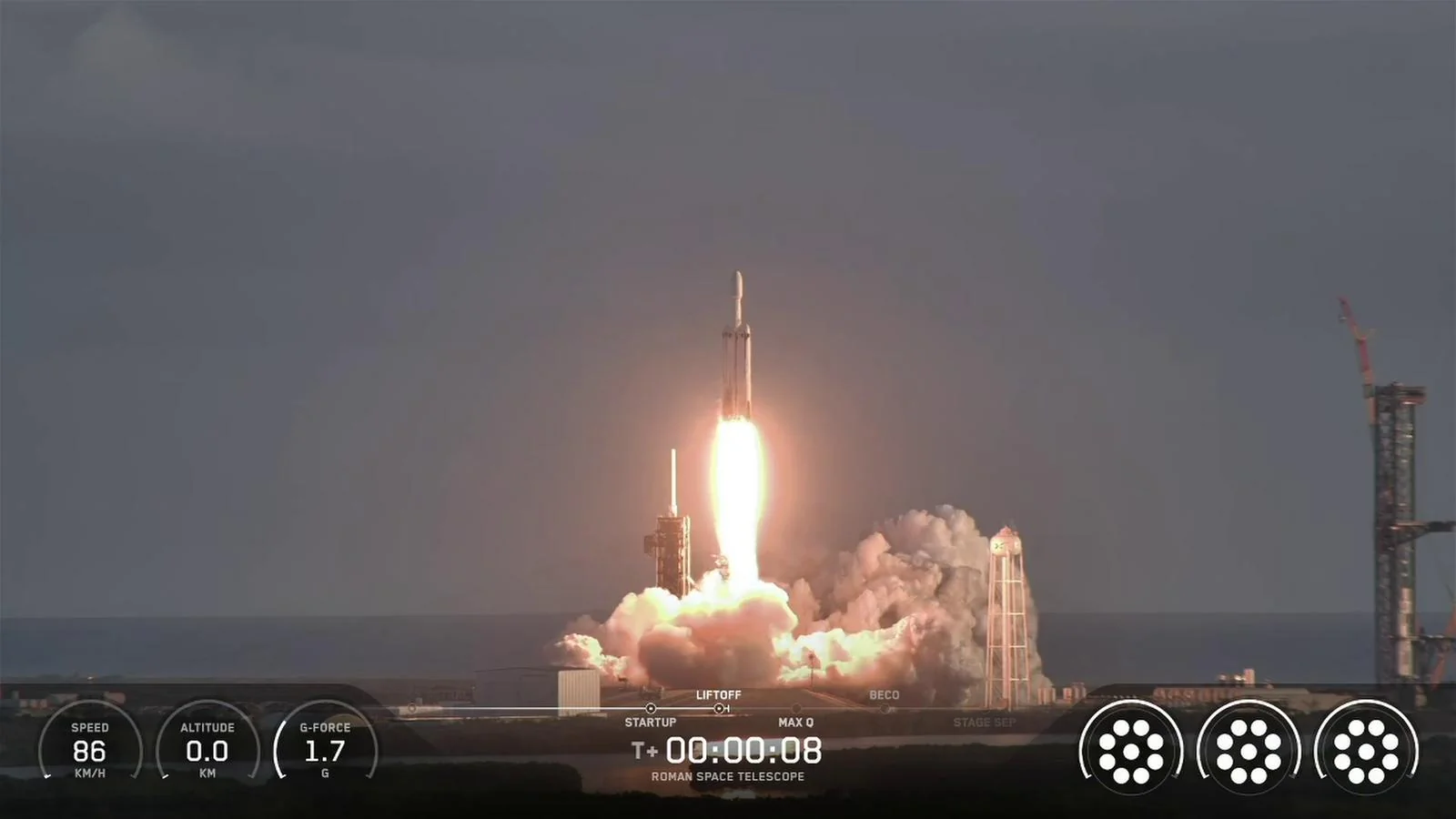
SpaceX, a leader in the aerospace industry, has successfully launched the Nancy Grace Roman Space Telescope, one of NASA's next-generation astronomical observatories, into orbit. This significant scientific milestone opens doors to immense opportunities for humanity to study the most mysterious aspects of the universe, including the nature of dark energy and exoplanets. This was reported by Ixbt.com reports .
According to ixbt.com, the heavy-lift Falcon Heavy rocket lifted off from pad LC-39A at the Kennedy Space Center in Florida on August 30 at the scheduled time. Notably, the rocket launched successfully on its first attempt without any delays. This flight marks the thirteenth successful launch for Falcon Heavy, not the tenth, further confirming the company's reliability.
Technical details and space maneuvers
During the flight, the rocket's structure performed with its usual high precision. After liftoff, the two side boosters of the Falcon Heavy separated from the central core and successfully executed return maneuvers. Both boosters landed safely at the U.S. Space Force base at Cape Canaveral, although the central core was not recovered in this mission.After the rocket's upper stage delivered the telescope to its initial orbit, it performed an additional engine burn to establish the required trajectory. SpaceX specialists confirmed that all stages proceeded as planned. The observatory separated approximately 31 minutes after launch.
Scientific goals and immense opportunities
The final destination for the Roman telescope is the vicinity of the second Lagrange point (L2) of the Sun-Earth system, located approximately 1.5 million kilometers from our planet. The famous James Webb Space Telescope is currently operating effectively in this same region. The new observatory is designed for wide-field surveys of the universe, investigating the nature of dark energy, searching for exoplanets, and studying the evolution of stars and galaxies.According to NASA, one of the key advantages of the new telescope is its extremely wide field of view. In a single session, Roman is capable of capturing a portion of the sky approximately 100 times larger than the Hubble telescope. It can also survey the sky more than 1,000 times faster than Hubble.
Future research prospects
As part of the primary scientific program, scientists plan to collect unique data on more than 2 billion galaxies. In just one month of observations across the Milky Way, Roman could register up to 20 billion stars, thereby creating the largest astronomical object catalog.For reference, the telescope is named after Nancy Grace Roman, NASA's first chief astronomer, who played a huge role in the development of space astronomy and earned the honorary title 'Mother of Hubble.' The primary mission of the Nancy Grace Roman is scheduled for five years after the start of scientific operations, and NASA intends to extend this period by another five years if the observatory remains in good working order.


Comments 0
…