


China to launch 30 satellites to monitor the space between Earth and the Moon
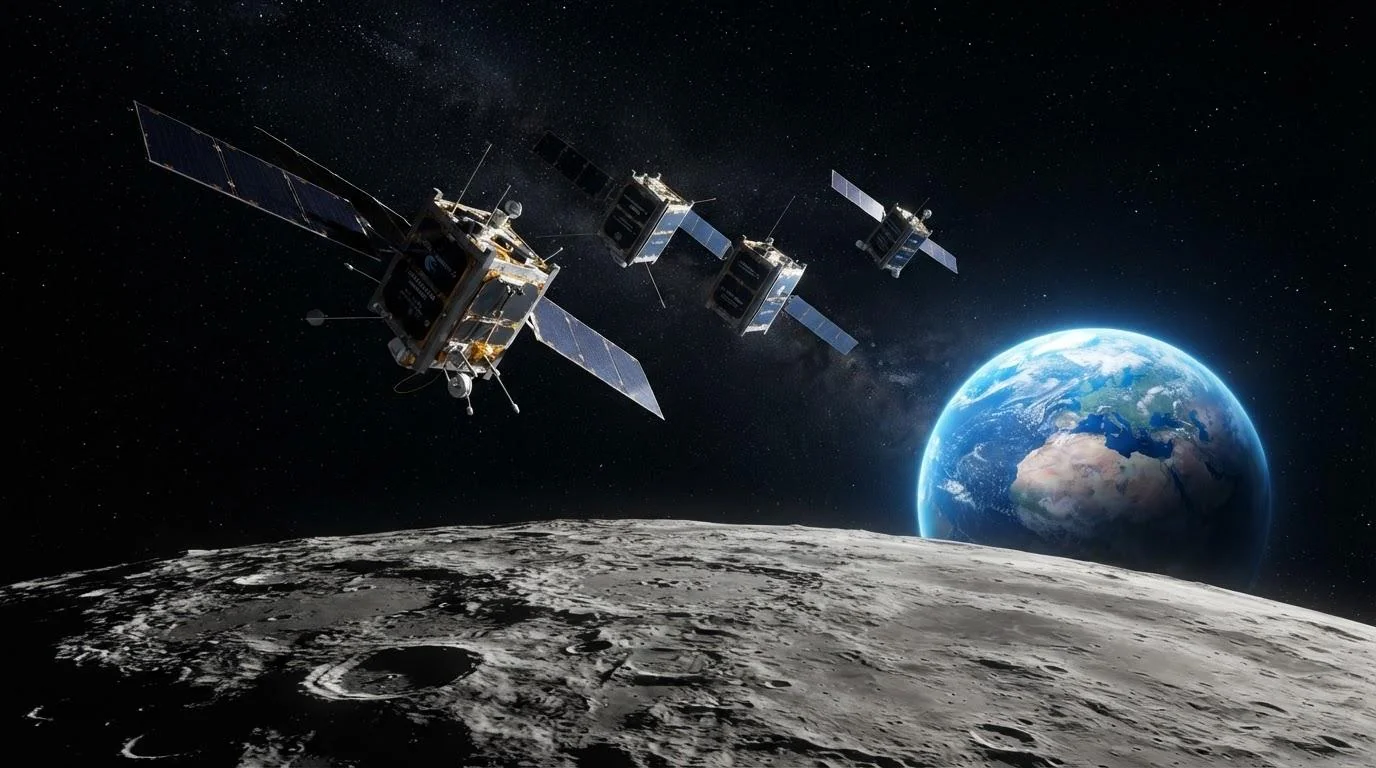
China has announced a large-scale international scientific project aimed at continuous exploration of the space between Earth and the Moon. According to ixbt.com, this project, called the Earth-Moon Cube Constellation, will create a distributed group of small satellites, which will be fully operational by 2030. This is reported by news source.
Details of the initiative were presented at the Deep Space Exploration (Tiandu) 2026 conference held on September 4. The core of the new system will consist of 30 12U CubeSat format devices, each weighing up to 30 kilograms. These satellites are planned to be launched into a high-elliptical resonant Earth-Moon orbit via six separate missions, with some devices to be placed in lunar orbits.
Continuous space monitoring mission
The main goal of the project is to transition from irregular observations by individual spacecraft to continuous monitoring of the entire Earth-Moon system. Operating simultaneously from various points in space, the satellites will study space weather, radiation conditions, record gamma-ray bursts, and collect data necessary for exploring lunar resources.According to experts, this network will allow for the determination of gamma-ray burst source coordinates with sub-arcsecond precision. It will also create a foundation for tracking the development of solar and magnetospheric events across the entire lunar vicinity.
International cooperation and prospects
Today, the Earth-Moon space, covering the area from low Earth orbit to 2 million kilometers from Earth, remains a largely unexplored zone. Most data comes from individual missions that do not provide continuous measurements. However, in the coming years, this region will host crewed expeditions and the formation of future lunar infrastructure.The project is being implemented by China's Deep Space Exploration Laboratory and the International Deep Space Exploration Alliance, with the support of the Asia-Pacific Space Cooperation Organization. Scientific organizations from Thailand, Serbia, Egypt, Senegal, and Indonesia have already joined.
China intends to provide partners with three types of standard scientific equipment free of charge: high-energy particle detectors, space magnetometers, and gamma-ray burst recorders. Participants will jointly develop technical standards, share scientific data, train specialists, and coordinate the development of the entire constellation. Currently, the first phase of engineering work has begun, with the design of the satellites and ground control complex nearing completion.


Comments 0
…