BepiColombo, having traveled 10 billion kilometers, approaches Mercury
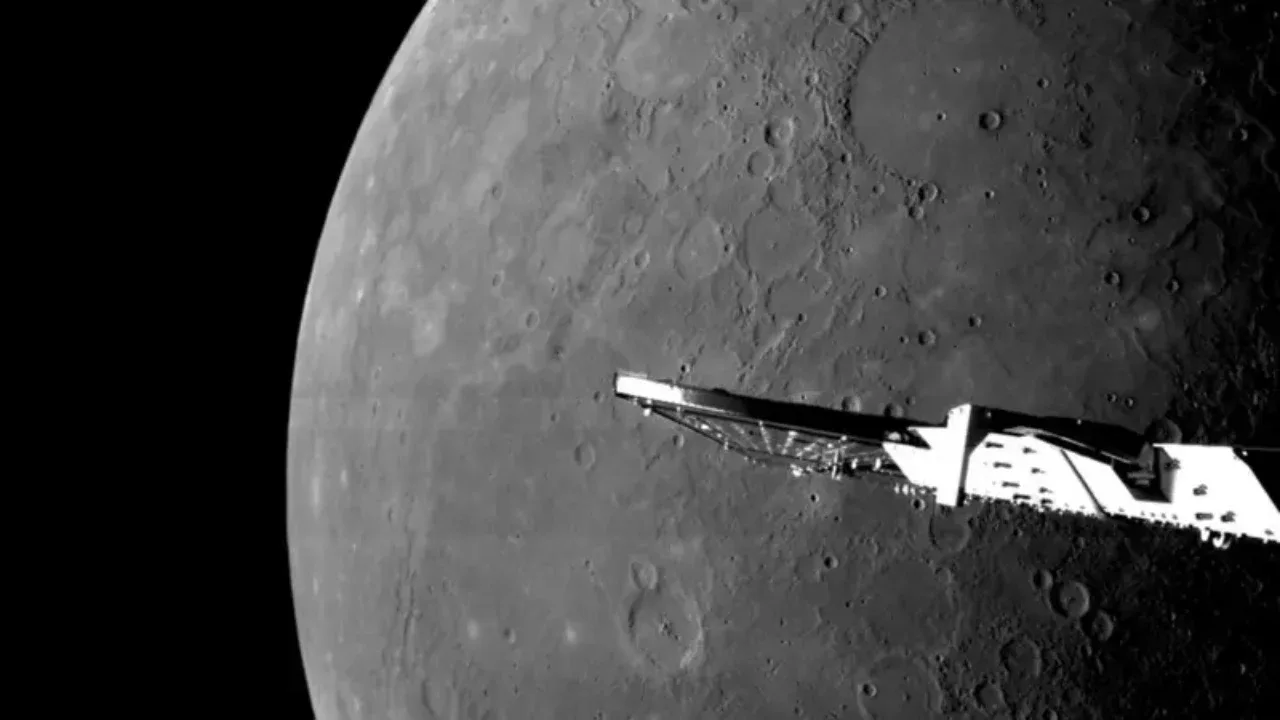
BepiColombo, a spacecraft that has covered a distance of 10 billion kilometers, has reached a close proximity to Mercury and is preparing to enter its orbit. This mission is a joint project of the European Space Agency (ESA) and the Japan Aerospace Exploration Agency (JAXA).
The craft must operate under extremely harsh conditions: on the surface of Mercury, the planet closest to the Sun, temperatures can reach +430°C during the day and drop to −180°C at night. Furthermore, the planet is constantly exposed to intense solar radiation.
Eight-year flight and an 11-minute risky maneuver
BepiColombo was launched in 2018 from a spaceport in French Guiana. Due to the Sun's powerful gravitational pull, the craft had to constantly reduce its speed (brake) and continuously adjust its trajectory throughout the journey.
Using planetary gravity, over the course of eight years, the craft has:
Fown around Earth 1 time,
Fown around Venus 2 times,
Fown around Mercury 6 times.
The most dangerous test awaits the craft as it enters Mercury's orbit: for the planet's gravity to capture it, BepiColombo must reduce its speed to the required level within 11 minutes. If the maneuver does not go as planned, there is a possibility that the craft will fly past the planet and drift into deep space.
Mission Aspect | Information and details |
Organizers | European Space Agency (ESA) and Japan Aerospace Exploration Agency (JAXA) |
Launch year and location | 2018, French Guiana spaceport |
Distance covered | 10 billion kilometers; gravitational maneuvers (Earth — 1, Venus — 2, Mercury — 6) |
Temperature and environment | Temperatures from +430°C to −180°C, intense solar radiation |
Orbit entry test | Speed reduction maneuver within 11 minutes |
Planetary mysteries: ice, hollows, and a massive core
Until now, only two NASA missions have approached Mercury: Mariner 10 flew by three times in the 1970s, and in 2011, MESSENGER entered orbit, operated for four years, and discovered ice in polar craters.
Through this new mission, scientists aim to clarify the following issues:
Ice in craters: How ice manages to persist in the planet's craters despite its proximity to the Sun;
Mysterious hollows: The origins of thousands of geologically young depressions, approximately 100,000 years old, which are clustered together with steep walls and appear unrelated to meteorite impacts;
Extraordinarily large metal core: The properties of the planet's massive metal core, despite it being smaller than the Moon.
BepiColombo carries two orbital spacecraft, which will separate a few weeks after reaching Mercury: the ESA craft will observe the surface from close range, while the JAXA craft will conduct observations from a much higher orbit.
In your opinion, how will discoveries regarding the mysterious hollows on Mercury's surface and the planet's massive metal core contribute to our understanding of the evolution of the Solar System? Leave your thoughts in the comments!

No ads with a subscription
Zamin Premium — 4 900 UZS a month


Related news


Comments0
…