


Will 'O‘' and 'G‘' be written differently now? The Senate approved the law on alphabet reform
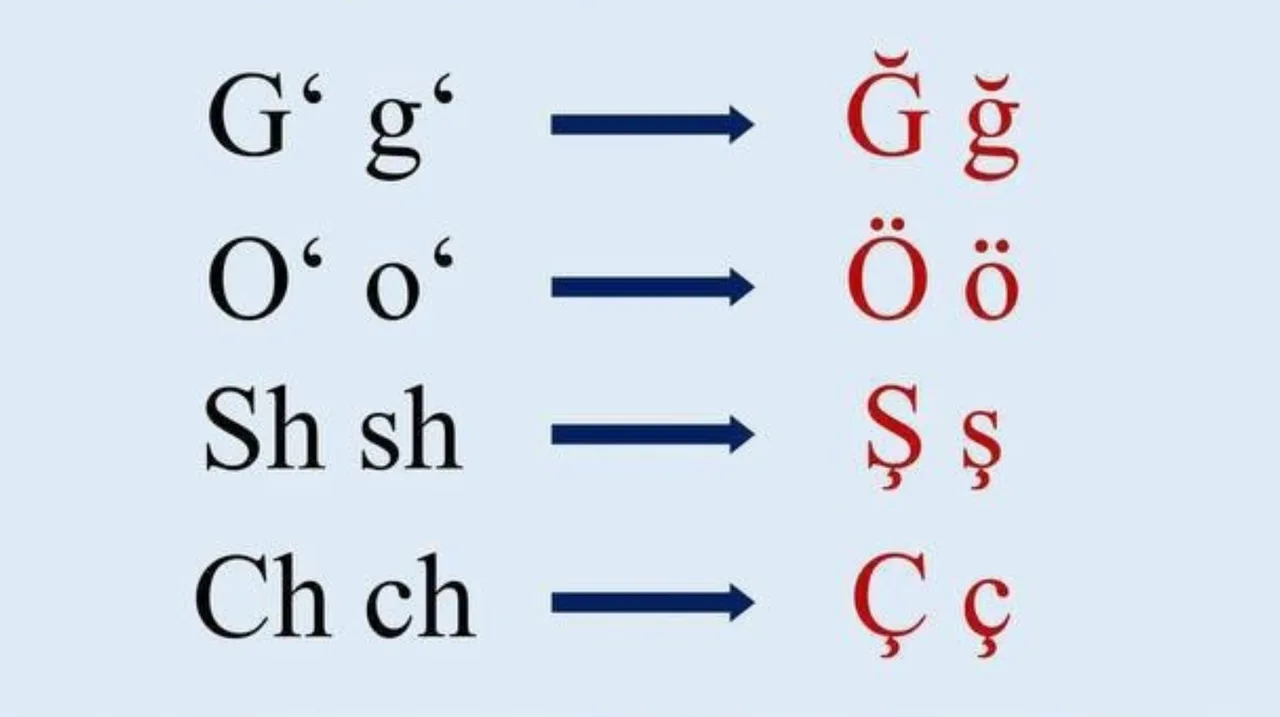
Years of discussions regarding changes to the Uzbek Latin-script alphabet have returned to the agenda. The proposed new form envisions representing characters like O‘, G‘, Sh, and Ch with a single letter.
However, there is an important detail: I could not find confirmed reports in open, official, and reliable sources stating that the Senate approved this law specifically on September 10. There are reports that the Legislative Chamber adopted the project and sent it to the Senate back in July. Therefore, in the material below, it is preferable to present the Senate stage cautiously rather than as a confirmed fact.
What changes are expected in the Uzbek alphabet?
The draft law provides for transitioning from the current 26 letters and 3 letter combinations to an alphabet consisting of 28 letters and 1 apostrophe (tutuq belgisi).
The most widely discussed changes are as follows:
Current form | Proposed form |
|---|---|
G‘ g‘ | Ğ ğ |
O‘ o‘ | Ö ö |
Sh sh | Ş ş |
Ch ch | Ç ç |
It was also proposed not to retain the "ng" letter combination as a separate letter.
Why are these specific letters being changed?
The main idea of the reform is to express certain sounds in the Uzbek language using a single independent letter instead of two characters.
For example, in current writing:
O‘ → Ö
G‘ → Ğ
Sh → Ş
Ch → Ç
may transition to these forms.
This approach aims to get closer to the principle of one character per sound. Discussions on the draft law also focused on simplifying the practical application of the alphabet and eliminating problems associated with certain characters.
What will ordinary text look like?
To visualize the new form, a few examples are sufficient.
O‘zbek → Özbek
O‘zbekiston → Özbekiston
G‘alaba → Ğalaba
Shahar → Şahar
Choy → Çoy
Thus, certain sounds currently represented by two or more characters may in the future be expressed by a single special letter.
This will require computer keyboards, phone language settings, electronic documents, and software to be adapted to the new characters.
The most interesting question: will documents change immediately?
No. The draft law also envisages a gradual implementation approach for the changes.
In particular, discussions on the project noted that documents executed before the law enters into force, as well as the national currency and securities, will remain valid, and state organizations will be able to use their signboards, symbols, and other attributes until a specified deadline.
This means there is no basis for concerns that all documents, signboards, and writings will be replaced in a single day due to the alphabet change.
Where will the greatest impact of the changes be felt?
If the reform is finally adopted and put into practice, the changes will be felt most of all in the education system and official correspondence.
Schools will need to teach the new letters, adapt textbooks and teaching aids, and introduce the new characters into keyboards and electronic systems.
Additionally, adapting internet search engines, e-mail, websites, databases, and various software programs for the Uzbek language will also be of significant importance.
Key figures regarding the new alphabet
Current system:
26 letters;
3 letter combinations;
certain sounds consist of two characters.
Proposed system:
28 letters;
1 apostrophe;
G‘ → Ğ;
O‘ → Ö;
Sh → Ş;
Ch → Ç;
not keeping the "ng" combination as a separate letter.
The draft law was adopted by the Legislative Chamber on July 7, 2026, and sent to the Senate.
Most importantly — the change does not come into force automatically yet
This is the most common misconception regarding this issue.
The Legislative Chamber's adoption of the project does not mean the alphabet has already changed. There are further stages for the project.
Therefore, it is incorrect to conclude that "writing Ö instead of O‘ and Ğ instead of G‘ is now mandatory" before the official entry-into-force procedure is determined. First, the Senate's decision, followed by the signing and official publication of the law, must be completed.
Currently, verified information in open sources indicates the Legislative Chamber stage.
Is it time to say goodbye to 'O‘' and 'G‘'?
If the proposed reform fully enters into force, the visual appearance of many familiar words in the Uzbek language will change.
O‘zbekiston — Özbekiston
O‘zbekistonlik — Özbekistonlik
G‘alaba — Ğalaba
Shahrimiz — Şahrimiz
Chiroyli — Çiroyli
At first glance, these characters may seem unusual. However, the human eye gradually gets used to the new writing as well.
Now the main issue is even bigger than the shape of the letters: how smooth the transition to the new alphabet will be, how millions of documents and electronic systems will be adapted, and how the public will accept this change?
These very questions are expected to be among the most debated topics in the next phase of the alphabet reform.



Comments 0
…