


US Lifts Half-Century Ban: Era of Supersonic Flights in Civil Aviation
The US Federal Aviation Administration (FAA) has announced a new draft regulation expected to mark a sharp turning point in civil aviation history. The document envisions revising a restriction that has been in effect for over half a century, prohibiting supersonic flight over land. This step could pave the way for a new generation of airliners in the aviation industry and significantly reduce intercontinental travel times. Ixbt.com reports on this.
The currently effective ban was introduced in the 1970s due to the powerful shock waves (sonic boom) generated by supersonic aircraft. The newly proposed standard, rather than banning flights outright, is based on limiting the sound pressure level that reaches the ground. According to ixbt.com, if the excess pressure generated by an aircraft does not exceed 5.3 Pa (0.11 lbs/sq ft), it may be permitted to break the sound barrier over US territory.
Technological Limitations and the Concorde Legacy
For comparison, the legendary Concorde airliner, flying at Mach 2 and an altitude of 15.8 km, produced a ground-level pressure of 1.94 lbs/sq ft. This is roughly 18 times higher than the newly proposed limit. This is precisely why Concorde was forced to conduct its supersonic flights only over oceans. Even considering that Space Shuttle vehicles returning from space generated around 1.25 lbs/sq ft of pressure, one can understand just how strict the new standard is.Under the new rules, manufacturers will be able to employ two different methods. The first is the "Mach cutoff" regime, in which specific atmospheric properties cause the shock wave to dissipate before reaching the ground. The second is the use of next-generation aircraft built on "low-boom" technology. These types of aircraft will feature a special aerodynamic shape designed to minimize the shock wave as much as possible.
Next-Generation Airliners: Boom Supersonic and NASA Projects
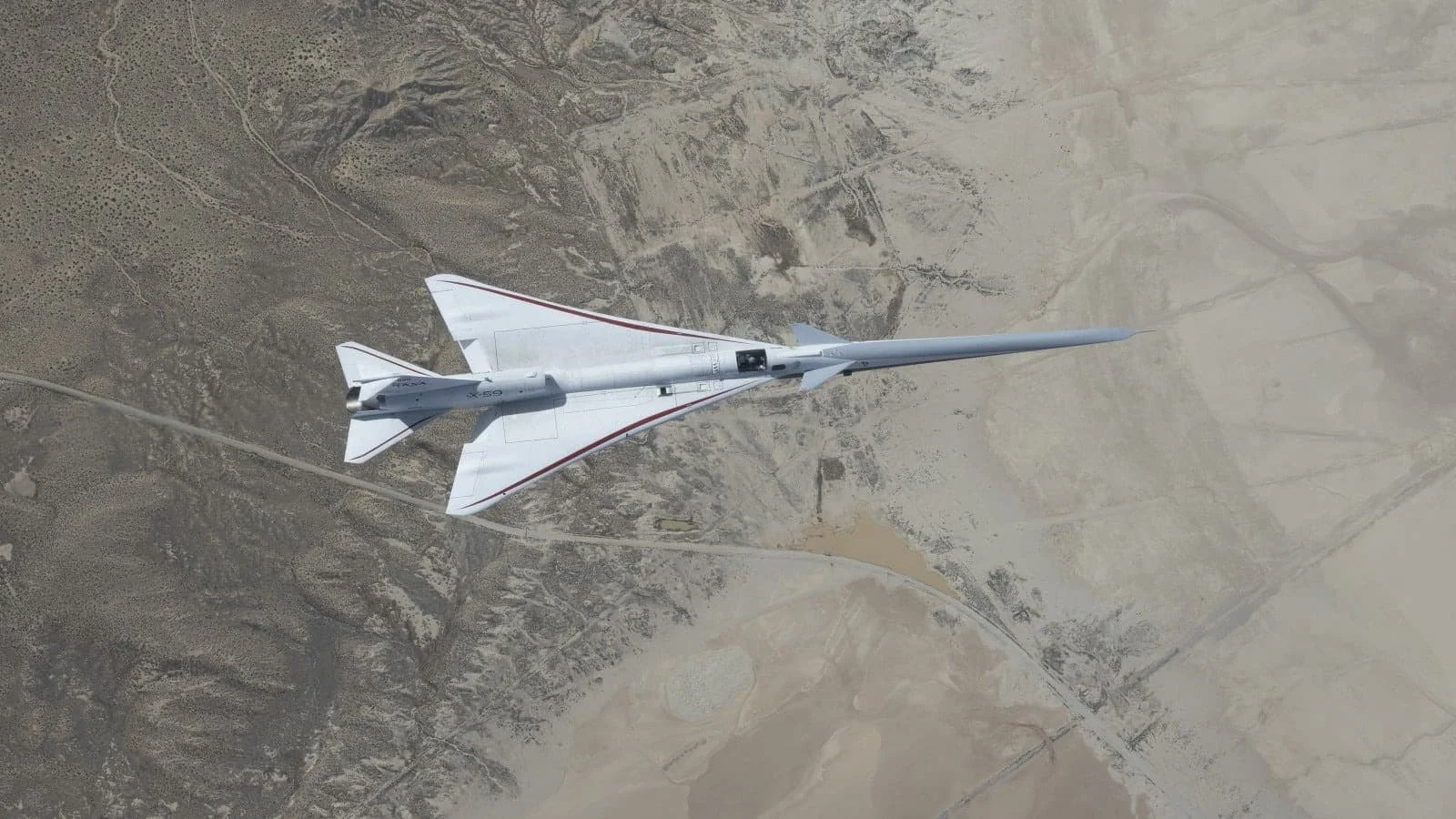
Currently, Boom Supersonic is leading the way in this field. In February, the company's XB-1 experimental aircraft flew at Mach 1.12 and recorded no sonic boom on ground sensors. According to the company's specialists' calculations, the future Overture passenger airliner will be able to reduce transcontinental flight times by at least an hour and a half through a "quiet" flight mode at Mach 1.3.Additionally, NASA is implementing the Quesst program in collaboration with Lockheed Martin. The X-59 aircraft developed under this project is designed to transform the traditional hard boom into a soft "rumble" thanks to its extremely long nose section. In June, this vehicle successfully broke the sound barrier and will continue test flights over various US regions in the near future.
Although technological advances are clearly visible, it will still take many years before production supersonic airliners appear. The certification process for a new type of civil aircraft in the US typically takes 5 to 9 years, and developing an entire platform may require more than a decade. Nevertheless, major airlines have already lined up: United Airlines has pre-ordered 15 and American Airlines 20 Overture aircraft.


Comments 0
…