


Bone kept for 40 years turns out to belong to Antarctica's first dinosaur
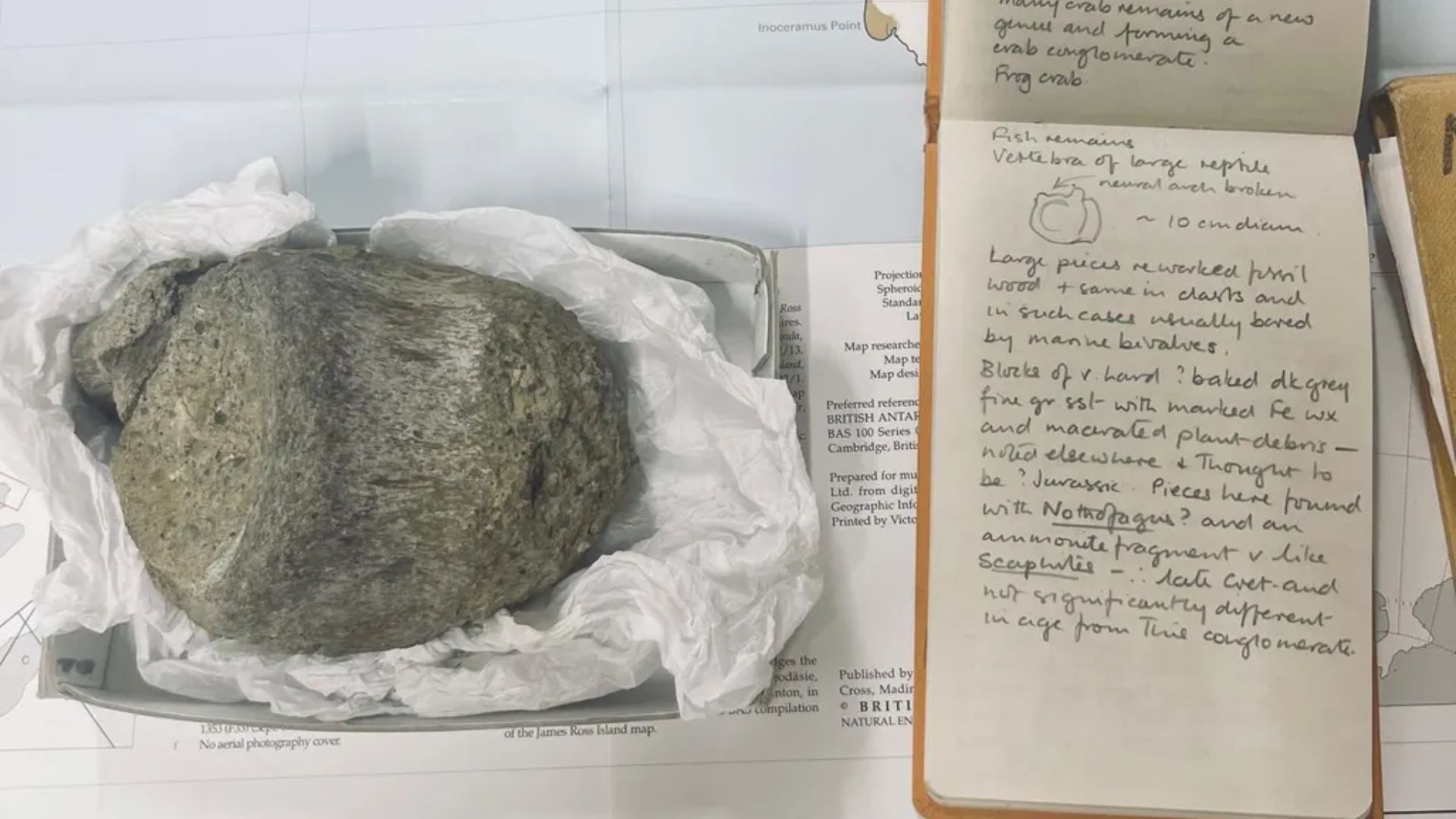
For 40 years, a fragment of bone kept on a museum shelf was considered an ordinary exhibit, but it has turned out to be one of the most important discoveries in Antarctica's history. Scientists confirmed it as the first dinosaur bone found on the continent.
This fossil was found in 1985 in Antarctica on James Ross Islandduring an expedition. However, since it could not be precisely classified, the bone was British Antarctic Survey (BAS)'s geological collection in Cambridge, stored among thousands of specimens.
Nearly four decades later, while re-examining the specimen, BAS collections manager Dr. Mark Evans noticed it was no ordinary fossil. While the original expedition participants thought the bone belonged to a marine reptile, Evans noticed it closely resembled a dinosaur vertebra.
The find was then sent to Natural History Museum paleontologist Professor Paul Barrett. The specialist examined it carefully and confirmed that this titanosaur was a tail vertebra of a giant plant-eating dinosaur called a titanosaur. He noted that the special joint structure on both sides of the bone is characteristic of this species and rarely found in other dinosaurs.
To date, more than 100 species of titanosaurs are known. They are among the largest creatures ever to have lived on Earth. Some reached lengths of 35 meters and weights of up to 60 tons. The owner of the specimen found in Antarctica was approximately 7 meters long. Scientists speculate it was either a young dinosaur or one of the relatively smaller titanosaur species.
According to experts, this dinosaur lived 82 million years ago during the Late Cretaceous period. At that time, Antarctica was not covered in ice sheets as it is today, but was instead covered with dense forests, making it a favorable environment for giant herbivorous animals.
According to paleontologists, this discovery further enriches our understanding of Antarctica's ancient ecosystem. It also serves as an important source for studying how dinosaurs lived on the continent and their interactions with other animals.
It is noted that the scientific article about this discovery was published in the journal Acta Palaeontologica Polonica . This once again confirmed that a forgotten fragment of bone for 40 years holds a special place in the history of Antarctic paleontology.


Comments 0
…