


Scientists recreate the color-changing property of 1,600-year-old Roman glass
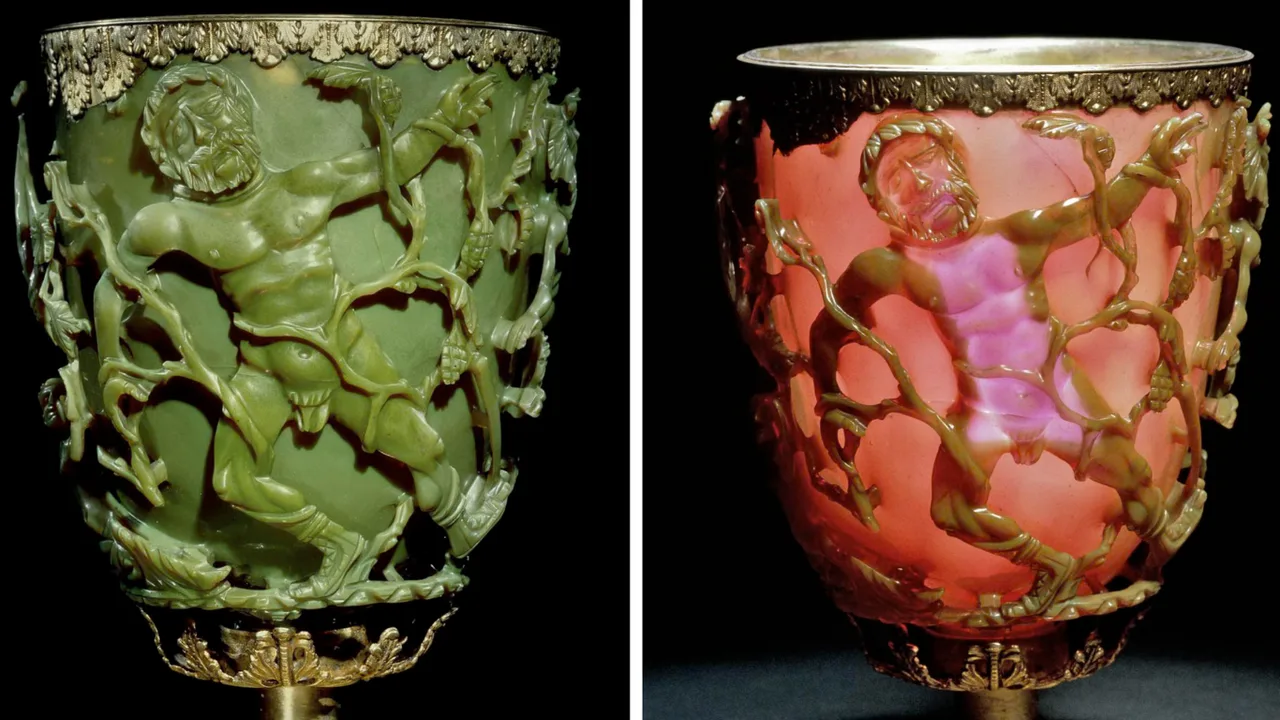
Scientists at the University of Sheffield in Great Britain have managed to recreate the property of ancient Roman glass that changes color when exposed to light. This was reported by The Guardian on October 25, 2026.
We are talking about the roughly 1,600-year-old Lycurgus Cup kept in the British Museum. It appears green in normal light and ruby red when backlit. This unusual property has baffled historians and glassmaking experts for centuries.
To recreate this phenomenon, scientists relied on an ancient glassmaking method. In the experiments, very tiny nanoparticles of gold and silver were added to the molten glass. The glass was melted at temperatures exceeding 1,000 degrees, and as it cooled, nanoscale metal particles formed inside it. As a result, a color change similar to that of the ancient cup was observed.
Researchers explain that the nanoparticles in the glass interact with light. When light passes through the glass, some of the blue and green colors are blocked, revealing red and orange hues. When light is reflected off the glass surface, it appears green.
Dr. Lisa Hollands, a staff member at the university's School of Chemical, Materials and Biological Engineering, noted that achieving this result was a long and arduous process.
“For me, this is a miracle,” she said.
Dating back to the 4th century, the Lycurgus Cup is decorated with scenes from ancient mythology. It depicts the victory of the wine god Dionysus over King Lycurgus. In 2022, international experts recognized the cup as one of the seven wonders of glass art in the world.
Ian Freestone, professor emeritus of archaeological materials at University College London, noted that the glass created by University of Sheffield scientists is closer to the original bowl's green and red colors than previous experiments.
According to the expert, the final color of the glass also depended on the conditions during its melting process, including its placement inside the kiln. This shows that it was not easy for ancient Roman craftsmen to precisely control such colors.
As part of the project, glass artist Elliot Walker also created a modern sculpture inspired by the ancient cup. This work will be exhibited at the Millennium Gallery in Sheffield from November 6 to 15, 2026. Later, it is planned to be permanently housed in the Turner Museum of Glass.
Scientists believe this research will help better understand the methods ancient Roman craftsmen used in glassmaking. It also demonstrates the possibilities of recreating the unique optical properties of historical glassware using modern methods.


Comments 0
…